About Porter
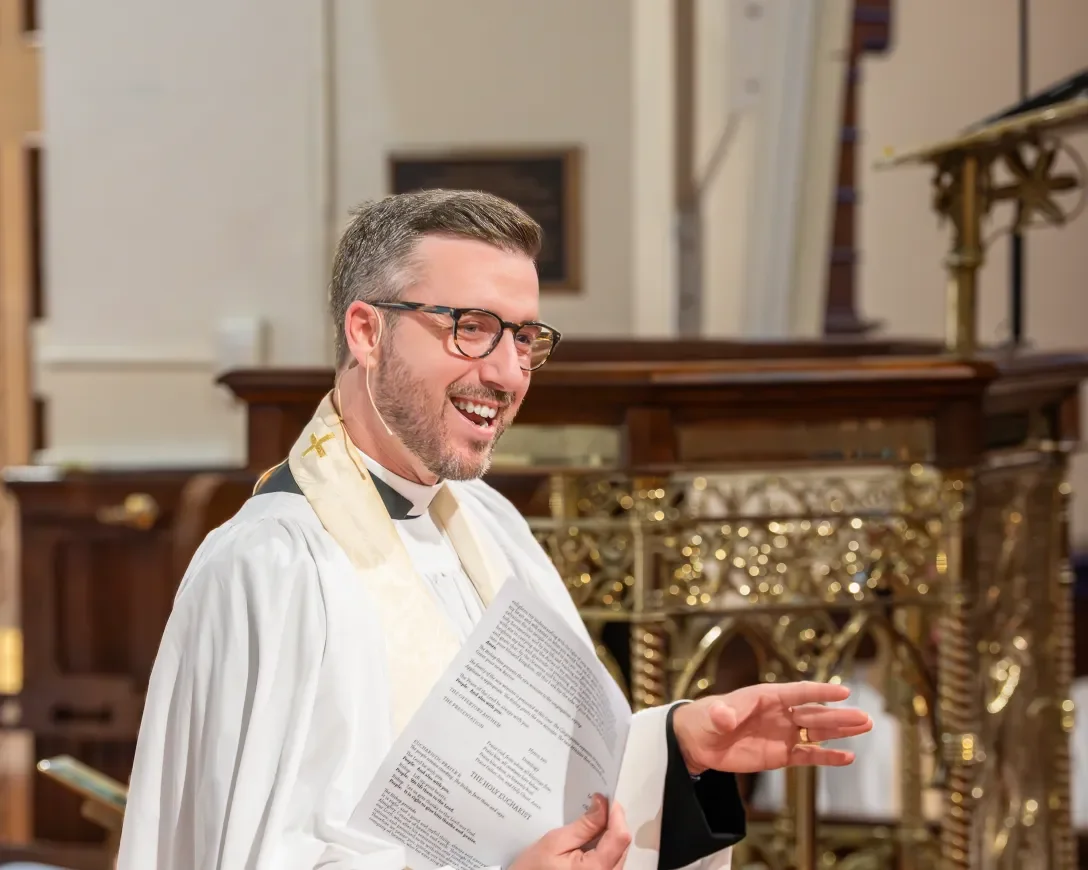
The Rev. Dr. Porter C. Taylor is an Episcopal priest and liturgical theologian. Ordained since 2013, Porter has served as rector in parishes in Augusta, Georgia and Cocoa Beach, Florida. As the rector of St. David’s by the Sea in Cocoa Beach, Florida, he founded the St. David’s Institute, a theological resource and training center. He previously served in diocesan leadership in California and at two church plants in California and Kansas. His work has appeared in Christianity Today, Notre Dame’s Church Life Journal, and The Living Church.
Porter holds a PhD from the University of Aberdeen in practical theology with a focus in liturgical theology, a fancy term for the belief that the Church’s worship is the primary expression of her faith and theology. He has taught at Fuller Theological Seminary and is scheduled to teach an intensive at Truett Seminary (Baylor University) in January 2027. He has two forthcoming books: More Anon: Essays in honor of Fleming Rutledge (Eerdmans, 2027, co-edited with Amy Peeler)and A Re-Introduction to Liturgical Theology (Wiley Blackwell, 2027). He is also co-editor (Khalia Williams) of The Wiley Blackwell Companion to Liturgical Theology and contributing editor of We Give Our Thanks Unto Thee: Essays in Honor of Fr. Alexander Schmemann (Wipf & Stock).
While he will always have a foot in academia, Porter’s true vocation lies in the local parish where he can help equip God’s people for Kingdom ministry through the intersection of tradition and innovation. He is especially energized by preaching, liturgy, leadership development, discipleship, and accessible theology.
Porter has been married to his college-sweetheart, Rebecca, for eighteen years, and together they have three sons, Jet, Case, and Ellis. He loves reading (both to himself and to his boys), spending time with Rebecca, needlepointing, and taking every opportunity possible to talk about Manchester United or the Baltimore Orioles.

Point of clarification: This Porter is not Bishop Porter Taylor. They do not share genetics, just a name that lends itself to an impressive number of “you’re looking for the other Porter Taylor” email responses. If you’re looking for Bishop Porter Taylor, you can find him here.
And tell him I sent you.

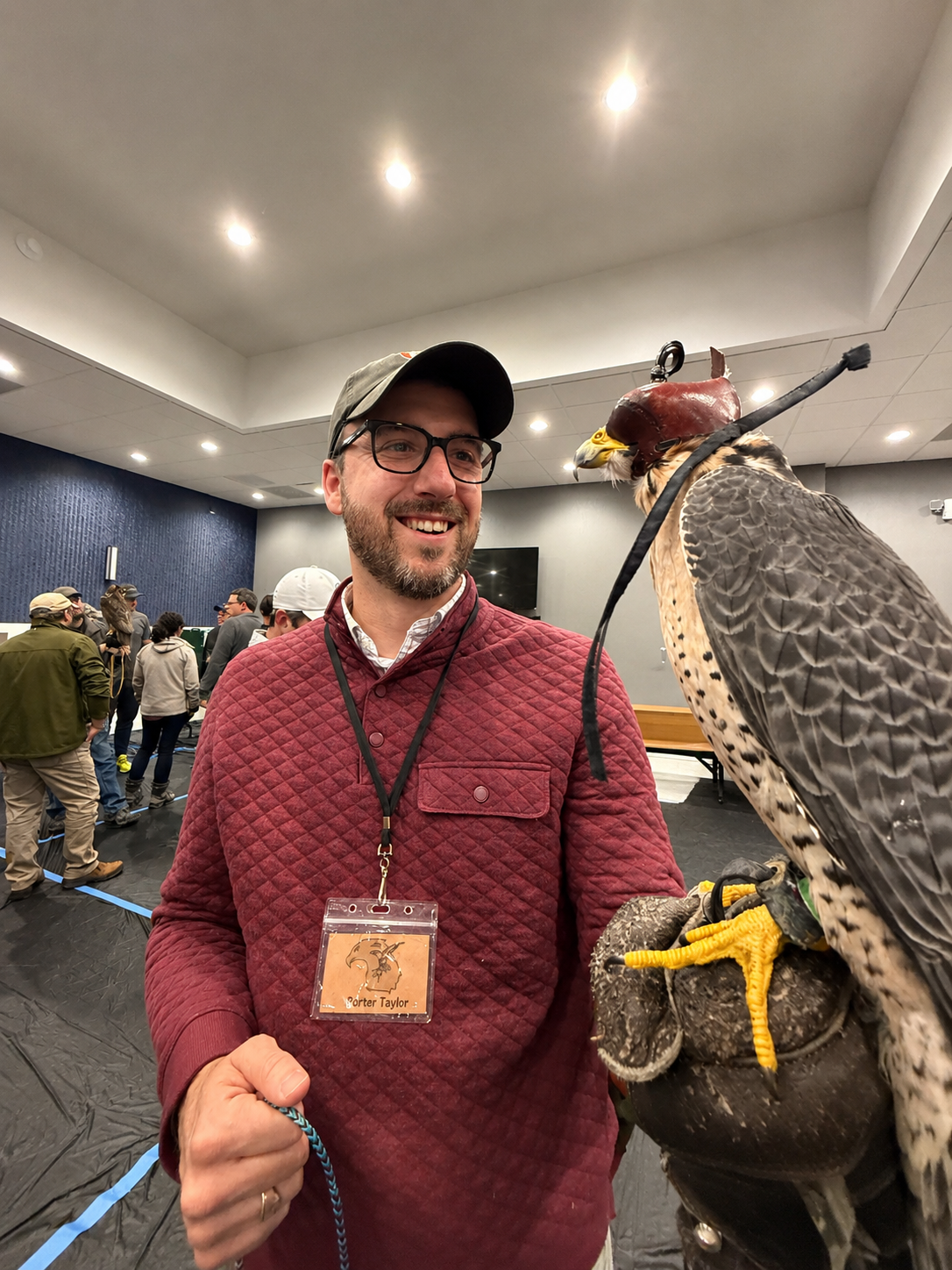
While the use of a falcon in my monogram logo was an intentional decision, it is a symbol which requires an explanation. The inspiration for the design goes back to an experience in 2025 when I took our oldest son, Jet, to the Apprentice Academy hosted by Georgia Mountain Falconry and the inimitable Buster Brown. We spent time with owls, hawks, falcons, and a golden eagle, and learned valuable information about the ancient sport of falconry.
The symbols of falcon and falconer bring to mind two of my favorite poems: “The Second Coming” by W.B. Yeats and “The Windhover” by Gerard Manley Hopkins. These poems and our encounter at the Apprentice Academy formed an intersection which resulted in a sermon that I preached days later wherein I argued that Christ is the falconer and the Church is the falcon. You can read and listen to it here.
On Falcons
Divine Allurement
The relationship between falcon and falconer is significant. The falconer teaches the falcon to trust and the falcon must learn to obey the call of the falconer. There is training, there are tidbits, and there is a lure. The falconer uses the lure to train the falcon by recalling the raptor back to himself. The lure leads to trust.
This image has been used by theologians Ashley Null and Zac Hicks in their works on the life and theology of Archbishop Thomas Cranmer. Cranmer was the architect of the Book of Common Prayer and an avid falconer. Null and Hicks suggest that Cranmer’s falconry was central to his liturgical and theological convictions. They identify the grace and forgiveness offered through the work of Jesus as a divine allurement, intended to recall humanity back to her God.
In Christ we have our Falconer. He uses the wonder of his grace, as enfleshed by Scripture and the prayer book, to lure our hearts to him. The Christian life is, in no small part, the lifelong schooling of the heart to recognize the call of Christ and return.
The falcon, then, is more than a personal logo. It is a reminder of who we are, whose we are, and the One to whom we are always being called home.