
On Confirming Youth
This post is part of “Ecclesia Anglicana,” a series devoted to all topics pertaining to Anglicanism. Stay tuned for more!
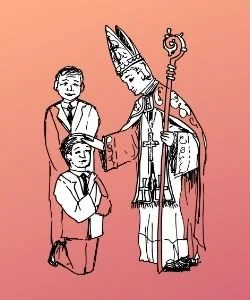
I did not grow up in the Anglican church. My teenage years were split between a Messianic Jewish synagogue and a Grace Brethren congregation. So, at a distance, the sacrament of confirmation looked like a cool rite of passage for my Episcopalian friends. But on February 11th, 2018, I received the laying on of my Bishop’s hands with this blessing:
“Defend, O Lord, this your servant,Hunter, with your heavenly grace, that he may continue yours for ever, anddaily increase in your Holy Spirit more and more until he comes into thefullness of your everlasting kingdom.”
This sameconfirmation prayer occurs in every iteration of the Book of Common Prayer,always emphasizing mature perseveranceas an intended fruit. I received thissacrament as an adult who, at that point, had served as a youth minister forsix years, yet I experienced a new vigor in receiving the Eucharist andparticipating in parish life. Perhaps my own confirmation experience makes meacutely aware of a common disparity between the theology of confirmation andthe practice of confirming youth in the Anglican church. It seems to be thecase that parish catechesis risks merely preparing youth confirmands for therite of confirmation while the liturgy and theology of confirmation treats thesacrament as an initiation into life-long, Holy Spirit-filled perseverance. Theresult of this disparity is a generation of youth fully initiated into a Bodythey are unprepared to participate in long-term. Thus, the Church risksperpetuating another achievement for youth to attain without life-longpractices and perspective. So, the question, “Are you initiated?” may not be ashelpful for confirming youth as, “What are you initiated into?”
Now, thereis no ecumenical consensus on the timing of confirmation. Our Eastern Orthodoxfriends do not separate baptism and chrismation, while Anglicans, like ourRoman Catholic friends, withhold confirmation until a child or adult may takereasonable, mature ownership of their faith. However, the question of what youthare initiated into remains for every Christian tradition. In what follows, Iwill explore the way a strong method and theology of confirmation moves youthbeyond the words of a catechism and the works of piety into a perseveringdesire for the Triune God.
Words, Works, and Desire
What prepares a young person forconfirmation? The numerous catechisms written since the Protestant Reformationseem to answer: systematic content. The Apostles Creed, the Lord’s Prayer, theTen Commandments, and the Sacraments become jumping off points into a didacticprocess whereby the catechumen ought to know what these teachings meanand why they occur in the Church’s liturgical life. Now, it may be unfair todiagnose this method as overly cognitive in its scope, yet youth confirmandsexperience that, in order to be confirmed, you must learn what these wordsmean. Under this view, catechism concerns the meaning behind the words andworks of the Church. William Cavanaugh addresses a similar problematic methodat work in the Eucharist. “The problem is that the Eucharist has been reducedto the message, to a piece of information for the mind to grasp. … The key isnot what the Eucharist means, but what it makes. And it makes the Church.”[1] Surely the sacrament of confirmationalso ought not be reduced to merely confirming what someone knows.
Since alittle ressourcement goes a long way, let us consider a catechetical methodfrom the early church. In DeCatechizandis rudibus,St. Augustine responded to Deogratias, a deacon in Carthage, regarding how todeliver a proper catechism. This deacon, celebrated in doctrinal knowledge andeloquence, struggled to deliver the scope of the Christian faith without boringhis catechumens. What is Augustine’s advice?
The narration is complete when thecandidate has received instruction from that first passage in Scripture, “Inthe beginning God created the heavens and the earth,” all the way up to thepresent age of the Church. But this does not mean that those of us who havememorized the whole Pentateuch, all the books of Jewish kingdoms and Ezra, thewhole Gospel and the Acts of the Apostles, should rehearse them verbatim. …Rather we should offer a brief and general summary, selecting particularpassages that occasion wonder and pleasure in the hearer and also form thesinews of the story.[2]
Certainly,Augustine is not implying that parts of the Biblical narrative are unimportant.His narrative method is intentional, knowing that where one starts affects thewhole and must fit together with all other pieces.[3] The goal of catechetical instructionis “love proceeding from a pure heart, good conscience, and unfeigned faith.”[4] Much like the hermeneuticinstructions in De Doctrina Christiana, Augustine emphasizes the desirefor and enjoyment of the Trinity as the ultimate end of all instruction.
So, howdoes Augustine’s narrativemethod answer what catechumens are initiated into? A catechism beginning with aselective biblical narrative (1) shows that the catechumen/confirmand is partof and participates in the public story of God’s redeemed people and (2)assumes this story will inspire wonder and pleasure for a life-long pursuit ofGod. If I might expand Augustine’s illustration, the sinews of the biblicalnarrative are sufficient for the catechism because they prepare the confirmandto be a full part of the Body of Christ, rather than an individual initiatedsolely on their mature knowledge.
Confirmationgives young people something to long for beyond the moment of initiation: adaily strengthening by the work of the Holy Spirit. The theology ofconfirmation points to this very reality. In baptism, the Church is united toChrist’s death and resurrection. In theEucharist, the Body is united to Christ and one another through receiving Hisbody and blood. In confirmation, each believer participates in Pentecost. Anarrative catechism emphasizes a young person’s participation in a publicstory; initiation is participating and receiving that act of God whichinitiated and constituted the Church.
Throughout De Catechizandis rudibus,Augustine exhorts thelistener to consider what they really rest their hope upon. If you place itupon your personal character, you will not persevere. If you place it upon thecharacter and piety of others, you will not persevere. Augustine’s interest inthe chaff among the wheat takes a pastoral turn towards perseverance and thepurpose of Christian practice.
This is fulfilled by no one save theman who has received the other gift, the Holy Spirit, who is indeed equal withthe Father and the Son, for this same Trinity is God; on this God every hopeought to be placed. On man our hope ought not to be placed, of whatsoevercharacter he may be. For He, by whom we are justified, is one thing; and they,together with whom we are justified, are another.[5]
Herelies the mysterious hope in the sacrament of confirmation: that, by grace, wewill persevere in our desire for the God on whom, alone, our hope truly rests.Christian practices form persons who daily put their hope in God, awaiting thefullness of His everlasting kingdom.
A Practitioner’s Perspective
Disciplingteenagers is not an easy task. I studied youth ministry at a Christian college,served in youth ministry a non-denominational church for six years, and now Iam a student ministry director at an Anglican parish. I write as a practitionerseeking clarity and conviction for my own students, more like Deogratias thanAugustine! Yet I find that the Anglican tradition offers a uniquely helpfulperspective and practice for forming youth.
First,Anglican youth ministry is free to learn from any Christian tradition andpractice. Youth ministry, at least in the United States, began from a largersociological shift when the institution of public education functionallycreated a distinct people group: teenagers.[6] The Anglican Church can learn fromevery kind of response to this phenomenon, from movements emphasizingfamily-driven faith to methods presupposing teenagers are largely unchurched. Ihave every reason to study the Bible, the Book of Common Prayer, Orange’s “It’sJust A Phase” curriculum, Hillsong Worship, St. Augustine’s understanding ofthe Imago Dei, and missiologist Leslie Newbigin in order to catechizeand disciple students well.
Second, theAnglican tradition can be locally adapted for a variety of post-Christiancontexts. I serve a diverse, urban parish in the heart of a city nicknamed theHoly City for all the church steeples on the skyline. Yet my students attendschools, have jobs, and form friendships in spaces that relegate religiousbeliefs to private preferences. Thus, the methods of reaching teenagers andequipping parents will look different in a diverse, urban setting compared to asuburban, like-goes-with-like context. The Liturgy of the Word and the Liturgyof the Table will form parishioners in a Kingdom reality, but parish catechesismust adapt to the spaces where parishioners will go in peace to love and servethe Lord.
Third, theDaily Office is an ideal rhythm for worship and discipleship. It is relativelyeasy for young persons to read Scripture with the multitude of Bible apps andreading plans one download away. Yet the Anglican tradition gives youthministry a true gem: a pattern for how to hear, read, mark, learn, and inwardlydigest Scripture as a Body. Our parish now requires all confirmands, youth andadults alike, to learn and practice the Daily Office as a rule of life.
Finally,Anglican youth ministry benefits from strong sacramental theology and practice.On one morning of a youth service weekend at a nondenominational church, Istruggled to teach Christ’swords, “I am the vine; you are the branches. Whoever abides in me and I in him,he it is that bears much fruit, for apart from me you can do nothing.”[7] I realized I could not teach thispassage without treating the Eucharist as a true sacrament and not just amemorial ordinance. Christ’s words surely go beyond daily devotions and intothe constitutive reality of a Church united to Him in the sacraments. Youthministry, at least in the United States, risks merely moralizing Christianpractices without a historic sacramental theology, a risk still present even inAnglican parishes. The challenge of parish catechesis will always be to piercebeyond the meanings of a catechism into the mysterious initiation into a Bodyunited to Christ, “from whom the whole body, nourished and knit togetherthrough its joints and ligaments, grows with a growth that is from God.”[8] May our youth always persevere intheir desire for God and participation in the Body.

Hunter Myers is a Student Ministry Director at the Cathedral Church of St. Luke & St. Paul in Charleston, South Carolina. He earned his BA in Youth Ministry & Philosophy at Columbia International University. He is from a small town called Golden, Colorado.
[1] Cavanaugh, William. “Eucharistic Bodiesin an Excarnated World.” Lecture, The Intersection Conference, Atlanta, May 17,2019.
[2] Personal unpublished translation by Dr.Andrew Alwine, Associate Professor of Classics, College of Charleston.
[3] See Dr. Sarah Coakley’s understanding ofsystematic theology. Coakley, God, Sexuality, and the Self, 41.
[4] De Catechizandisrudibus, Chapter 2.6.
[5] Augustine, De Catechizandis rudibus, Chapter27.55
[6] John Berard, Rick Bartlett, JamesPenner, Consuming Youth: Leading Teens Through Consumer Culture.
[7] John 15:5, ESV.
[8] Colossians 2:19, ESV.