
This sermon was originally preached on November 19, 2023 at St. David’s by the in Cocoa Beach, Florida. The lections for the day were for Proper 28A (Track 1) and included Judges 4:1-7; Psalm 123; 1 Thessalonians 5:1-11; Matthew 25:14-30.
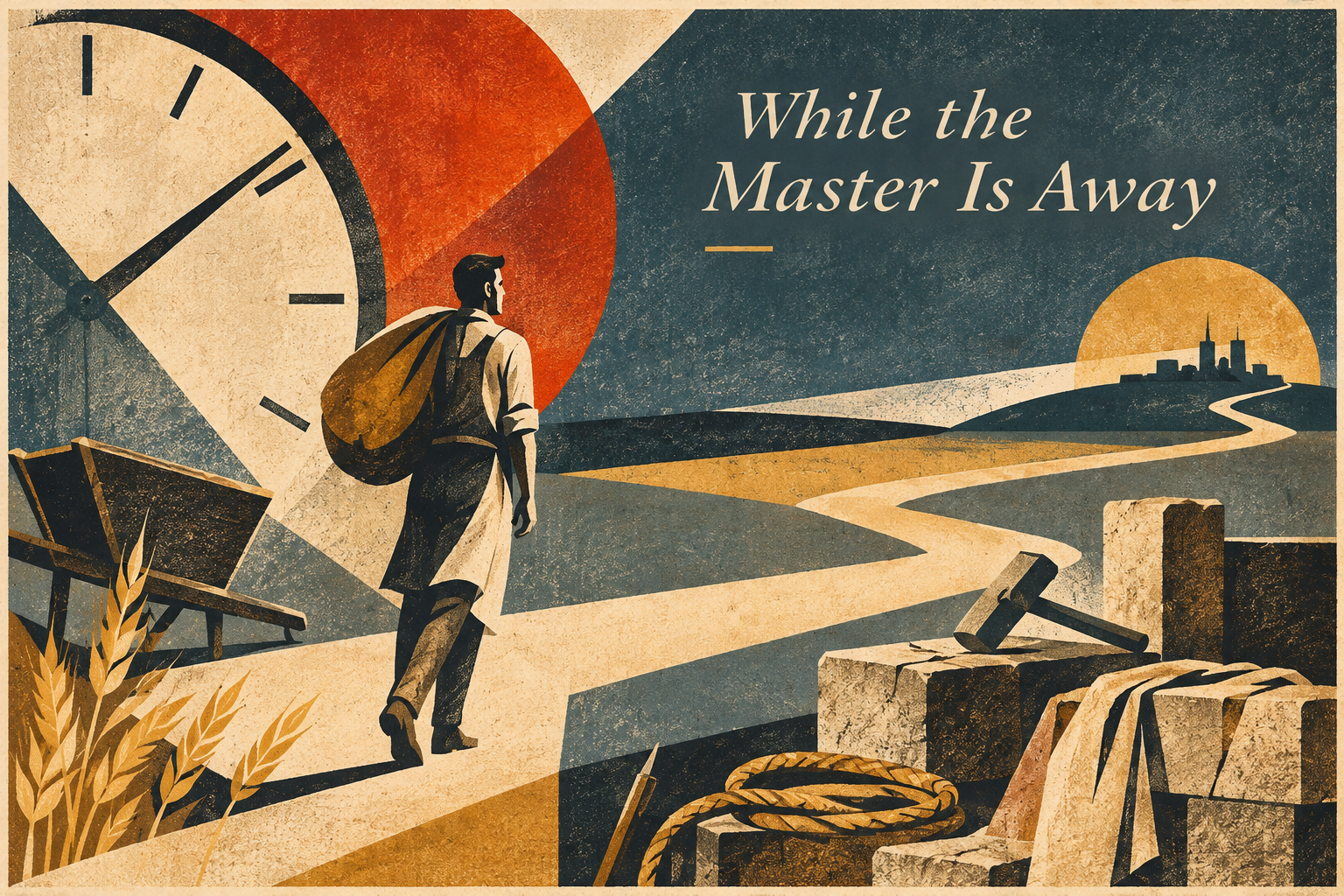
While the Master Is Away
I went to church a lot as a child. It was church on Sunday morning, youth group on Sunday night, and often a youth activity during the week. It was rare for me to not be at church at least 3 a week. A fellow priest with a similar upbringing said he had a “drug problem” as a youth…he was drug to church anytime the doors were open!
I grew up with a hefty dose of Bible trivia. I was constantly being quizzed on odd facts and random biblical tidbits.
Many of you look perplexed, clearly you never had to recite all 66 books of the Bible in order or participate in a sword drill. Because I want you to share my experience, I am going to give you a Bible trivia quiz…
I will give a book to anyone who can correctly answer four of these seven questions…
Q: What is the first car mentioned in the NT?
A: A Honda Accord. Acts 2 says, “They were all in one accord.”
Q: Who is the oldest person in the Bible and how old was he?
A: Methuselah; he was 969 years old.
Q: What is the first sport mentioned in the Bible?
A: Baseball. “In the big inning.”
Q: Who was the worst law-breaker in the Bible?
A: Moses; he broke all 10 commandments at once.
Q: Who was the greatest comedian in the Bible?
A: Samson; he brought the house down.
Q: What is a salesperson’s favorite Bible passage?
A: The Great Commission (Matthew 28)
Q: Finally, who is the only left-handed judge in the Bible?
A: Ehud
Our passage from Judges this morning gives us a brief reference to the only left-handed judge in Scripture. Ehud, we are told, thrust his 18-inch sword into the gut of King Eglon, someone whom the Bible describes as being “very fat.” How fat was he, you ask? So fat that when Ehud pierced his belly with his blade, the fat closed over the blade and he could not pull it out!
And who said the Bible is boring?
This is why Cranmer prayed that we should read, mark, learn, and inwardly digest the Bible.
This morning, on our penultimate Sunday before Advent, on the last Sunday before Christ the King Sunday, I want us to start with Paul’s letter to the Thessalonians and then settle in Matthew 25.
In our last reading from 1 Thessalonians, Paul is giving final marching orders to the church in Thessalonica. This paragraph falls within a larger section on Jesus’ return in the fullness of time to judge both the living and the dead. Of this second coming, Paul says, no one knows the time or the date. It will come like a thief in the night without warning or alarm. For those in Jesus, Paul continues, this should not “catch them out” or put them on their heels because they are children of the light, not of darkness; they are awake and sober rather than asleep and drunk.
Paul intends his comments here to be an encouragement to his people, especially to those who are already doing the right thing. This is the description of an eager anticipation, an active waiting for a hoped for event. This is not the last minute dread of procrastination or laziness. All of us can recall the feeling of pulling an all-nighter to finish the term paper or to file our taxes or to meet a work deadline. We also all know the feeling of an unexpected, unannounced visitor at the front wherein you frantically have to pick up the unfolded laundry, stuff dirty dishes in the oven, and shove toys under beds. In both instances, we run around, from whence to whither and hither to yon, without any real plan in place, just being spurred on by our urgency.
This is not the type of eager anticipation to which Paul is calling us.
It is not a matter of how-much-can-you-get-done-before-the-time-is-up, but rather an invitation to a slower and gentler way of doing things.
When we started our family economy a few months ago, which is just a really fancy term for an allowance, I noticed something miraculous with the boys. Part of their responsibilities were to make their bed every day, but I started seeing Ellis making his bed at 6:15 in the morning. What you need to know is that “awake time” isn’t until 7AM, but Ellis was so eager to start the new day because he was anticipating his new allowance, that he was making his bed at 6:15 in the morning.
That’s the kind of eager anticipation we’re talking about!
This is more like what Paul is describing.
We need to do the stuff now, we need to act the part now, so we aren’t caught without the proper wedding garments, without oil in our lamps, or with our talents buried in the sand.
For Paul, this eager anticipation includes his favorite triad of faith, hope, and love but here he orders them with faith and love first, and then hope.
Hope is something that we work toward.
Hope is something that we long for and strive after.
Hope is something that we see in the distance and begin pursuing.
The Thessalonians model for us the calling of every Christian: to be alert, to be sober, to encourage one another, and to build each other up. We must put on the armor of salvation, which includes faith, hope, and love. And with that hope, we long for the day…
When God will be all in all;
When God will make all of the sad things untrue;
When God will put all of the wrong things to rights;
When God will make all things new.
It was that faith, hope and love, which enabled the Thessalonians to live, act, move, and have their being in the present tense, in accordance with God’s will and way, in alignment with his kingdom in his glory.
But let’s turn to Matthew 25 for more on this.
This is the next to last parable before Jesus shares a meal with his followers on the night before he was betrayed and handed over to suffering and death. This parable comes immediately on the heels of the Parable of the 10 Virgins from last week.
Before we can talk about what this parable is, let me give you a fair-warning about what it is not: this is not a story primarily about financial stewardship nor is it a tale about spiritual gifts. There are ways to relate both of those subjects to the parable, but to make either the primary focus or to reduce the meaning down to one of these secondary or tertiary matters is to miss Jesus’ point entirely.
A wealthy landowner is going on a long journey and as part of his preparation he has entrusted his estate to his servants. We know very little about the landowner outside of his journey, his decision to entrust his estate to his servants, and his celebration or critique of how those servants performed.
A talent was a very large sum of money. While the denarius was the equivalent of a day’s wage, a talent is worth six thousand denarii. That’s approximately 16.5 years worth of wages. And to one servant, the master gives 5 talents – more money than the average worker could make in multiple lifetime; to another he gives 2 talents – about as much money as the average worker could in a single lifetime; and to the last he gives 1 talent – or, 16.5 years worth of wages.
He gave to each as they had ability. This is not a blind dart-throw, friends. The landowner is wealthy, yes, but he is not one to squander his assets and resources. This was a test for the servants, an opportunity to prove what they are capable of. The only true choice is to take that money and to grow it by hook or by crook.
Their job was to make sure that business continued to be profitable and efficient in his absence.
So the servants set about their business.
We don’t know how much time has passed, but we know that two of them got busy and one got nervous. The two who got busy were able to double the portions they had been given: five became ten and two became four. But the last one, the one to whom a single talent had been given, that one went out into a field, buried the money, and then did nothing with it.
Upon the landowner’s return, the servants are asked to give an account of their work on their master’s behalf. I think that gets lost in the shuffle a little bit, doesn’t it? They aren’t working for themselves. They haven’t become self-employed and presented with the opportunity to grow their own wealth. No. They are still servants of their master and have been charged with overseeing his finances, making his investments grow.
We already know that the first two doubled their initial investment, but notice what the master says to each of them: “Well done, good and trustworthy servant; you have been trustworthy in a few things, I will put you in charge of many things; enter into the joy of your master.”
They are praised for their work;
They are entrusted with more;
They are ushered into their master’s joy;
They are invited to share in his happiness.
But it is not to be so for the third servant.
When it is his turn to account for how he grew the master’s wealth, he is forced to tell the master that he did nothing. It’s even worse than that, actually. Doing nothing might have been permissible, but this servant did nothing because he believed his master to be harsh and dishonest. He goes as far as saying that he was afraid of the master and so he hid the talent.
The master points out that the servant is actually handing him less than what he originally started with because he didn’t even have the foresight to invest it with a banker to return some sort of yield to keep up with inflation. I mean, the prices for a package of pita and a tub of hummus had skyrocketed while the landowner was away. The cost of owning, feeding, and riding a camel was not what it used to be, I’ll tell you.
The master takes his own talent from the servant and he gives it to those who already have more. The servant is thrown into the outer darkness, where there is weeping and gnashing of teeth, because he did not trust the master, nor did he obey the master, nor did he do anything to serve the master.
As I read that passage again this morning, I was struck by a similarity with another biblical text of wrongdoing. I believe that this might help to make sense of what is going on here. In the beginning, back in the garden, Adam and Eve were entrusted with the care of creation. They had been given authority over every living thing and they were called to be fruitful and multiply, to fill the earth and subdue, to have dominion over the created world. The telos of their calling was to help creation flourish and return her praise to the creator.
But eventually they decided to strike out on their own, disobeying God because they believed that they knew better, and they sinned. When God, the landowner, comes “back” to where they are in the garden, they hide themselves.
Why? Because they were afraid.
Do we know what they feared?
I think we can easily surmise that they are afraid of punishment for failing. They had failed in their role as stewards of creation because they had chosen to take care of their own wanton, wayward desires instead.
Their fear reveals a deep truth about them rather than any reality about God. Do you see that? They distrusted God not because he had proven himself to be harsh or dishonest, but because they misunderstood who he was and what he was about. I think this is the same as the third servant.
The point of the story here isn’t the weeping and gnashing of teeth, although there is an element of judgment which we cannot avoid. Rather, the purpose of the parable is to call disciples into faithful practice and faithful living. Adam and Eve abandoned their work as stewards, burying it in the ground, as it were, and doing something else.
My friends, we are being reminded, encouraged, invited, and implored to not abandon the call in front of us. What have we, his servants, been entrusted with? We have been given the treasure of the gospel. Jesus, the owner of all that is, the cattle upon a thousand hills belongs to the LORD because the earth is the LORD’s and everything in it, that Jesus has given us the good news that in him there is eternal life. As bondservants of the King of kings and Lord of lords and as ambassadors of his reign and rule, we have been given the greatest news in the history of the world: that Christ has come into the world to save sinners and that everyone who calls upon the name of the Lord shall be saved.
We need help in our work, of course, because we are as faithless, fickle, and feckless from time to time and we know that we cannot do any of this under our own steam. Judges and Psalm 123 serve as a hopeful reminder that our help comes from the LORD, that he is merciful and all-powerful, and that he is mighty to save.
The gospel does not exist only for our benefit, however. It will not benefit anyone for us to hide the gospel on a shelf or under a bushel or to bury it in a field because we erroneously think the master is harsh. The gospel is meant to bless all the families and nations of the earth, every woman, child, and man. The work to which we have been given, that is the mission of mercy and the ministry of reconciliation, is a work which Jesus shares with us for the life of the world.
As we continue our runway into Advent, we are beckoned to follow Christ through preparation and obedience, faithful witness and faithful practice because of the redeeming work of a faithful God who wants us to enjoy his joy as his faithful servants. Amen?