
Sermon Commentary: Are You Envious Because I am Generous?
As part of my sermon for the Iliff Preaching Conference this week, I also presented a commentary on my sermon afterward. This practice is common in preaching conferences and homiletical circles. It is a craft which I discovered through Joy J. Moore, Matthew Skinner, and Karoline Lewis some years ago. I have found the practice of writing a commentary so helpful that I now do it for all of my sermons.
Commentary on “Are You Envious Because I am Generous?
Before I can even unpack my homiletical decisions and sermon content, I need to tell you how I got here.
When Dr. Moore gave me the prompt for the sermon – preaching in an age of contempt – I started overthinking it. And by overthinking, I mean my ego went into overdrive.
How can I be as creative and provocative as possible?
How can I prove myself by preaching to preachers?
What is the most firepower, prophetic, memorable sermon I can write to show my strengths?
I have a feeling I’m not the only one who has done that when faced with preaching on a specific topic or reading. In my earliest years as a wet-behind-the-ears preacher, I was constantly swinging for the fences. Every sermon was the bottom of the 9th inning with bases loaded, a full count, and World Series Game 7.
I hope you’ve been there, too.
Maybe it was preaching after Charlie Kirk; preaching after another school shooting; preaching in the age of overwhelming political power. Every time, there is a tendency to want to preach in a way that is more I than Thou, more Me than Thee.
I did not, in fact, need to manufacture a sermon based on my whims and wiles where I could show off. Rather, I needed to preach and get out of the way so the Word made flesh could show up.
As a preacher in the Anglican-Episcopal tradition who has spent substantive time among the baptists, reformed bros, evangelicals, and non-denomationalists (or, baptists again), my preaching is least about me and most cruciform and theocentric when I am using the lectionary.
I went to the lectionary and looked at the lections for the Sunday before and the Sunday after this conference. Ultimately, I selected the texts for this coming Sunday: Proper 20A - Track 2.
Within the context of a preaching conference sermon with no worship service attached to it, I was presented with a challenge: how do I put the full measure of Scripture before my listeners since I don’t have the Liturgy of the Word doing the work for me?
This is where y’all come in.
I made the decision as a preacher to trust you.
To trust your biblical knowledge – not as experts but as passable.
To trust that if you were my parish, you would know these stories enough to be dangerous.
But I also didn’t want to leave it entirely up to chance, either. That’s not a great place to be as a preacher. So I laced as much of the narrative and textual signals throughout the sermon without (hopefully) overwhelming you.
Those were the two hardest decisions for me to make, but once they were done the rest was simply a matter of wrestling with the word as the word worked on me. I am a profound believer that a true Christian sermon – and each of those three words is carrying a lot of weight – is one that is prepared prayerfully and playful with the word, under the authority of the word, with the sole purpose of point to the Word made Flesh with whatever words you have been given to speak.
My transition paragraph from sermon opening to formal exegesis is where I want to begin. I said: Those are hard words, grace and mercy. Not because of what they mean, but because of how they work. Or what they look like when they work.
In preaching to the preaching choir, I recognize that many may know the LaGuardia story. You know it because you’ve preached it, or you’ve heard someone else preach it before. I find this comforting and helpful.
Unlike my homiletical muses (Rutledge and Davis), or my homiletical friend with whom I often fight (Capon), I believe in sermon openings and illustrations. Not because they are Aristotelian rhetorical devices or oratorical skills. The goal isn’t to earn street cred with my “audience” or to entertain you so that you miss my sleight of hand when I start talking about Jesus. The sermon opening is an exegetical act. It is a practice of explaining, exploring, and expounding upon the Bible through simile, metaphor, narrative, or analogy in a way that brings the hearer into the story.
I sat with these texts for several days, reading, listening, prayerfully-and-playfully considering them. It became overwhelmingly clear to me that grace and mercy were the thread here…and that they were also the remedy to an age of contempt.
Before we joined the Jonah story, I told you precisely where our lectionary texts were taking us: grace and mercy and God’s victory.
This wasn’t a moment of superimposing a theme onto the lections in order to make them say what I wanted them to. Our job as preachers is to proclaim what God is proclaiming in Scripture without putting additional words in his anthropomorphized mouth.
One of my favorite homiletical moves is to give my answer or thesis as early as possible so it can work on you while you listen to me showing my biblical math, as it were. I did that at the bottom of page 2 – probably 3 minutes into the sermon – and then I repeated it throughout. Perhaps you caught it and can tell me what it was:
And when grace and mercy win, no one loses.
This was the sermon’s core. The Hemingway-esque six-word sermon would have been: grace and mercy win, nobody loses.
With grace and mercy established as my base note, the LaGuardia story was already readily available to me. In this story, I find Scripture being lived out as an embodied sermon.
I resisted the temptation to step into the story with a midrashic attitude as I did with the biblical texts. Of course I wanted to tease out what it must have felt like for those in the room to witness LaGuardia upholding the law and showing mercy. I wanted to pick on the shop owner for his hard heartedness, I wanted to sit with the claps and cheers as the grandmother was handed a hatful of money. Doing that, however fun it may have been, would have turned my sermon opening into the sermon itself. The goal was not to supplant Scripture but to help illuminate it.
That story is simple to slip into, though. Like most of Scripture, it is an easy move to imagine yourself as one of the characters or a fly on the wall. In fact, I was banking on your ability to inhabit the narrative faithfully and powerfully.
Finding yourself in the story allowed me to move beyond the story into the land of the text with our minds teeming with justice, grace, and mercy. One last word on the opening: it was an intentionally soft land because the ground I charted for us to cover in the rest of the sermon was more challenging. The goal was to lull and ease you into a false sense of homiletical security – before making the decisive turn.
The Jonah story was the key to the whole enterprise. We all know this story. Even more than the LaGuardia story (hopefully). We know it because we’ve heard from the nursery, in the pews, in seminary, and out in the wild world. There is something about the Jonah story that feels safe, as though we can handle being exposed to God’s uncomfortable mercy from a distance, like viewing a tiger at the zoo.
But do we really understand Nineveh?
We know it wasn’t Israel. We know they were bad people. But even as preachers we are probably not as up-to-date on who they were, how they lived, and what they worshipped.
I honestly believe that when most Christians hear Nineveh they think Not Us. And that’s certainly Step 1a of the exegetical process, but the backbone of this sermon was helping you take Step 1b.
Nineveh was more than not us, not here, not safe. More than a place without coke, grits, fried okra, or SEC football.
The Assyrians were blood thirsty butchers.
They were culture destroyers, civilization erasers.
And they were winning while Israel was losing.
Oppressors and the oppressed.
The call to Jonah wasn’t a call to a far-and-distant land like our romanticization of overseas mission work. No, it was a call into the heart-of-darkness and the only things which seem to bring Jonah any amount of comfort are a the enduring presence of God and his message of turn or burn.
For the sermon to hit and land, however, hearers needed to contextualize the Jonah-Nineveh contrast within their own hearts. It may not have been hard, but I’m sure it was uncomfortable.
Nineveh is whatever zipcode, family member, political party, politician, person, or people group to whom your heart has been closed off. And knowing our fallen nature, I knew it wouldn’t be hard for us to make that personal move.
I wanted one more moment of levity to really sink the hook in. Enter Sally Lloyd-Jones.
The Sally Lloyd-Jones bit is simply too good not to preach. Even if you’ve never read it before, it sticks with you. I had a parishioner in my previous church come up to me many months after I preached with that line and all he said, “One ticket to not Nineveh please.”
How good is that?
The phrase is delightfully and intentionally disarming. By softening the blow, as it were, we can enter into the story more fully with almost a beginner’s mind before I pull the rug out again. Not to hurt or to harm, not to have one over on you, but to finally let you hear the reality of the story when you’re actually ready for it.
Because the sermon wasn’t about Assyria.
It wasn’t about Nineveh.
It wasn’t even about Jonah but he gets us closer.
The sermon is about God.
As you know, Jonah is sitting on the outskirts of the city, in the sweltering heat, but his blood is boiling even hotter. Why?
The Ninevites converted.
His plant died.
God was gracious.
The prophet is bitter.
He had preached turn or burn, but his hope was for the latter not the former. As preachers, or even as Christians, in this contemptuous age, I believe we often have our minds made up about how God should treat someone else or handle a situation. Sometimes we preach with the message God has given us, but with our own preferred outcome for how it is received…iykyk.
Scripture tells us there were more than 120,000 people in Nineveh. Jonah preached, and an entire city repented.
And he was furious about it.
Jonah knew who God was.
He knew God’s heart for mercy and grace.
He knew God’s character of steadfast love and compassion.
Initially he wanted to flee, before rejecting it ultimately.
And finally, almost halfway through the sermon, we were ready for the first deep question: Can the prophet preach a mercy he secretly resents?
The same question sits before us today: can a preacher, can you, preach a mercy you secretly resent?
The answer may shock you: Yes! God can and will use your preaching even if you aren’t smoking what you’re selling. Such is the miraculous work of the Holy Spirit. Sermons are not effective, efficient, or efficacious because of our character as preachers…
And yet we are called to live with the word, by the word, under the word, to the glory of the Word made flesh. And while a preacher can preach a message he or she resents, Scripture would tell us that he or she shouldn’t.
Before turning to that homiletical move, I have one more lectionary-based preaching point to make: I don’t normally preach on all four lessons.
Sometimes I find the hallowed “golden thread” of all four lessons and the collect. Then I weave it throughout the sermon tapestry. This is fun, and it certainly teaches a church how to read the Word, but more often than not I am focusing on one lesson with others as supporting evidence. You will notice in this sermon that Jonah and Matthew were primary. The Psalm was very secondary. Paul was tertiary.
I’ll be stronger: I don’t believe every lectionary-based sermon should preach from all 4 lections. If you are in Track 1, you have more of a chronological presentation of the Old Testament and you have the ability to focus on the patriarchs, prophets, or kings and feed your people a steady diet of Christologically informed OT preaching. Track 2 is thematic and you can have OT and Gospel in more symbolic tension or alignment. All four lessons in one meal, however, can be exhausting and sometimes you need more meat than potatoes or veggies than salad.
Let’s quickly look at Matthew and how it functioned in the sermon. As with Jonah, I chose to trust that you were familiar with the story but I didn’t choose to put all of my trust in you. ;) I find it helpful, whether the lesson has been read ahead of time or not, to re-present the finer points of the lesson.
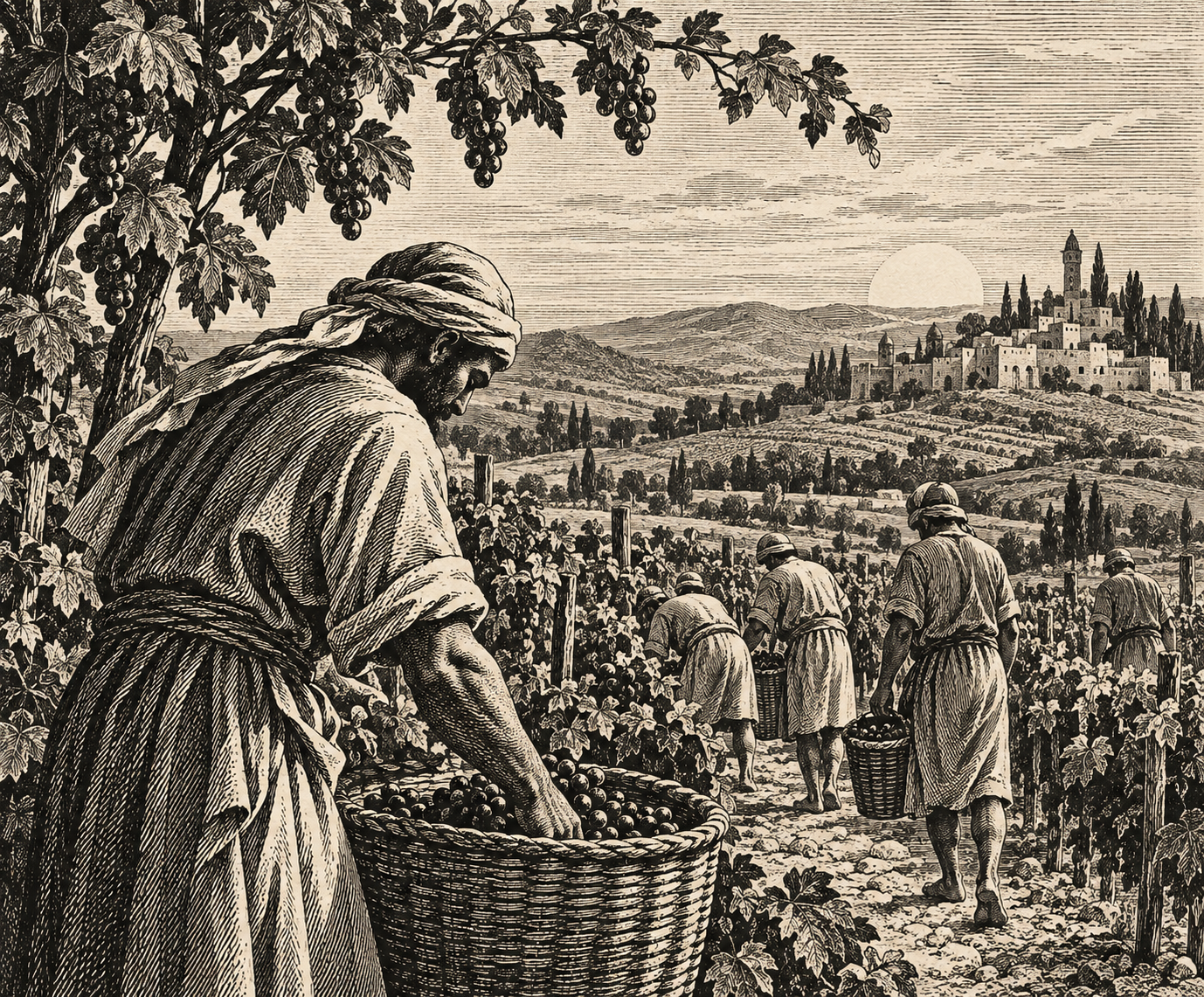
The parable of the Laborers in the Vineyard is one that we can immediately sink our teeth into, both because it is a well-trod tale and because it is something that we can readily understand in our economic environment.
A landowner goes out and hires day laborers for the vineyard. All that is guaranteed is work for the day. The pay isn’t promised – you just hope that you have been hired by a person with a reputation for treating workers well.
Clearly there is such great work required that they have to go back to Home Depot to find more workers. I made a very intentional decision here, but I wanted it to be subtle rather than becoming a central point of the sermon and that was in using the Lowes/Home Depot example. When I lived in Atlanta, it was common for landscape companies to send their foreman to one of these stores to find laborers. He would arrive where they were gathered, stick a hand out of the window signaling how many he needed, and they would hop in the truck.
These were migrants.
Likely underpaid in cash under the table.
The working poor as Dr. de la Torre said yesterday.
And then lather, rinse, repeat the next day.
If a foreman was not known for treating workers well, only the most desperate would step forward.
And if you were one of those workers, you did not want to be sitting in the Atlanta sun at noon or 3pm or just before quitting time.
We don’t know if they were desperate or ill-equipped or picked-over and looked-over when it came time to find help initially, but they are still there throughout the day and more and more come to the vineyard.
When the whistle finally blows, everyone knows it’s time to get paid.
I know you know this. But I want you to see what I was playing with.
We know last in, first (paid) out. That’s how this story works.
And it would be really easy to immediately point out the fact that the full denarius given to the latecomers is unfair and unjust, but we don’t know that.
Not yet.
Not in the story.
We aren’t aware that the longest workers are going to complain.
It’s important to not rush immediately into the outrage and anger that is hiding around the corner.
It’s important to try and let the text be the text without rushing to the good stuff.
We need to let it settle and sink in, let the word speak without speaking over it, or for it, or against it..
We hear the rhythmic clinking each time a new group steps forward. Each gets a denarius.
And each subsequent group is probably coming to the till with the expectation that they get more than the last group. And each time it’s the same. So you know what’s coming when the longest workers arrive: it’s like the punchline to a badly telegraphed joke…it was always going to be a denarius.
And do you notice how easily we become outraged on behalf of those workers? Maybe not today, maybe not the last time you heard it, but probably at some point in your Christian walk you heard the story and you felt the fire of justice burning for them…
But they weren’t treated unfairly.
They made the daily wage. It was the going rate. It was fair and just for what work they provided…
Rather than the landowner being unfair, he is generous. That’s the point here: he is generous and some are envious.
They just didn’t like being compensated the same as those other people.
The brilliance of this story is that Jesus lures everyone into a sense of picking a side…only to discover that in the use vs. them, we’ve chosen the wrong way. To start transitioning out of the text and into your hearts, I played with the us vs. them motif.
Instead of preaching about contempt by using real life examples of a contemptuous age when someone always ends up being the sin example much to their detriment, I wanted this sermon to remain true to the word and allow the Spirit to work on hearts by convicting and converting. By this point in the sermon, no one was wondering whether or not they had been part of creating an “us vs. them,” instead you were thinking through the “them” you had created.
Our lectionary texts have already done the theological work for us. Despite outward appearances or assumptions, they aren’t four unrelated readings.
They're one proclamation: God refuses to distribute grace according to human calculations.
Jonah...God has mercy on Nineveh.
Matthew...The landowner is generous to latecomers.
Psalm..."The Lord is gracious and merciful, slow to anger..."
Philippians..."Live in a manner worthy of the gospel."
The scandal of grace is not that God saves people we think don't deserve it. The scandal is that God saves people like us.
Grace should astound us and mercy scandalize us, not because other people are getting it, but because we have received it too.
Our three questions help us understand this contemptuous age and they allow us to see grace and mercy in greater relief; to see God’s steadfast compassion and unrelenting love in deeper clarity.
Can a preacher proclaim a grace he secretly resents?
Can a ministry mete out a mercy that affronts her?
Is the preacher, is the church, smoking what it’s selling?
You cannot preach against contempt by giving the congregation someone new to condemn or hold in contempt. The only way to preach against contempt is to throw yourself, your sermon, and your congregation on the rock that is Christ, on the ground that is holy, on the bush that burns yet is not consumed, on the lavish and radiant love of Almighty God which purges, purifies, convicts, converts, rescues, and redeems.
When grace and mercy win, God wins. And no one loses. Not shop owners. Not prophets. Not day laborers. Not you. Not me.