
Sermon: Forgotten Narration
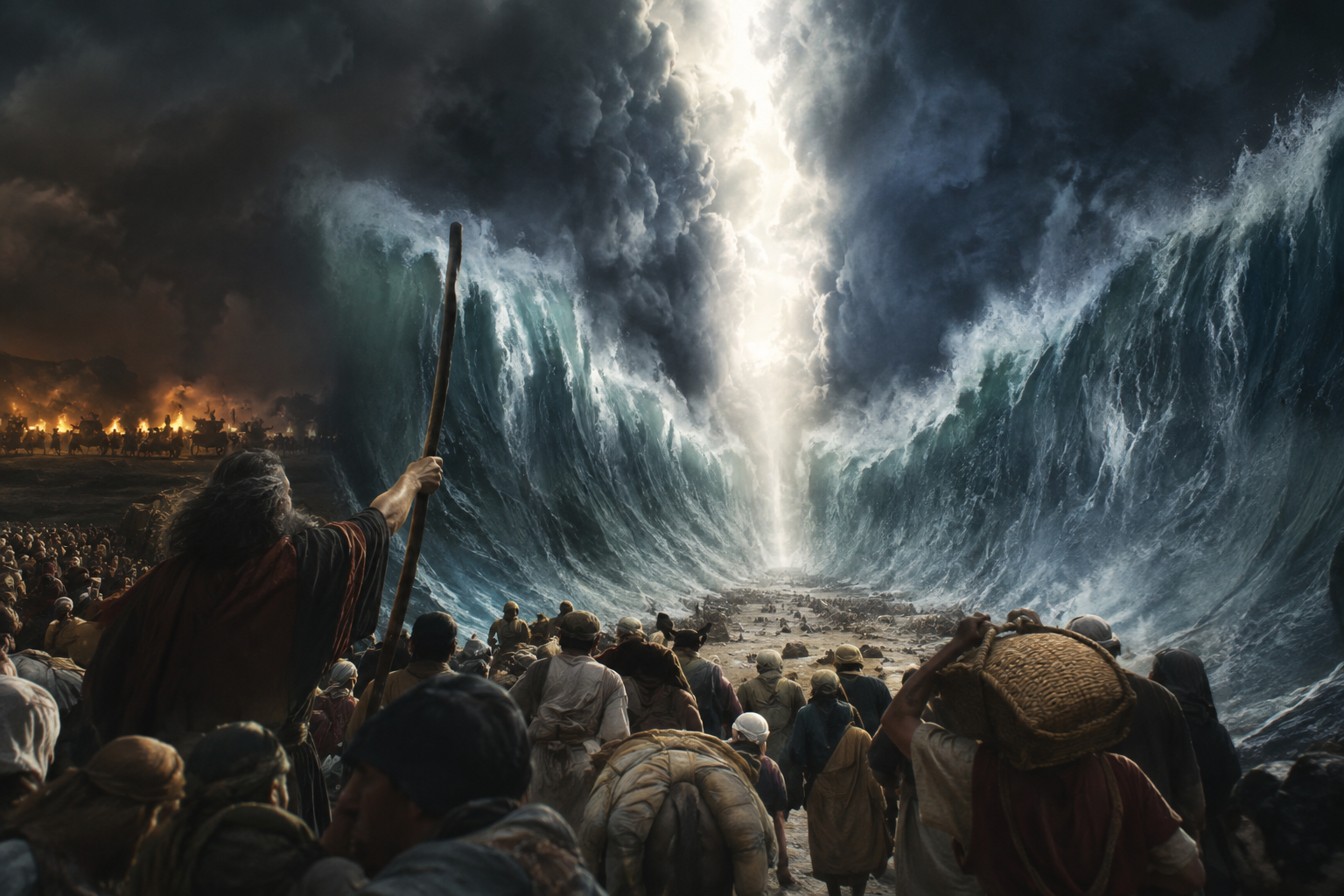
This is an image generated by ChatGPT with the prompt of a photorealistic, first-hand, eye witness account of Moses and the Hebrews with pillar of cloud (right), the Red Sea parting, and Pharaoh’s chariots in hot pursuit.
This sermon was originally preached at St. John’s Congaree in Hopkins, SC on Sunday, September 13, 2026 for Proper 19A. The lectionary texts for the day were Exodus 14:19-31, Psalm 114, Romans 14:1-12, and Matthew 18:21-35.
Forgotten Narration
A nation is its narration.
Such was Adam Gopnik’s claim in his 2023 book review of Jacob Wright’s, Why the Bible Began. (1)
Who we are is formed by how we tell our story. According to the musical Hamilton, it’s “who lives, who dies, who tells your story.” We all know the quote, misattributed to Churchill, that “History is written by the victors.” For the Hebrew writers of Scripture, Gopnik argues the reverse: the world’s most influential text comes from antiquity’s biggest losers.
Written with his typical Gopnikian eloquence and probing prose, he plunges the depths of the volume in question. Gopnik’s opening line is what captivated me. He wrote: The Moshiach came to Madison Avenue this summer.
I knew what he was talking about.
I knew it because I had seen it with my own eyes.
As the boys and I walked through Manhattan to grab a bagel that June, we stopped at the corner of 5th Avenue and 56th Street. Fixed on the backside of a walking signal was a picture of Rabbi Mendel Shneerson. Staring down at me, its text read: “Messiah is here!”
The Moshiach had indeed come to Madison Avenue that summer.
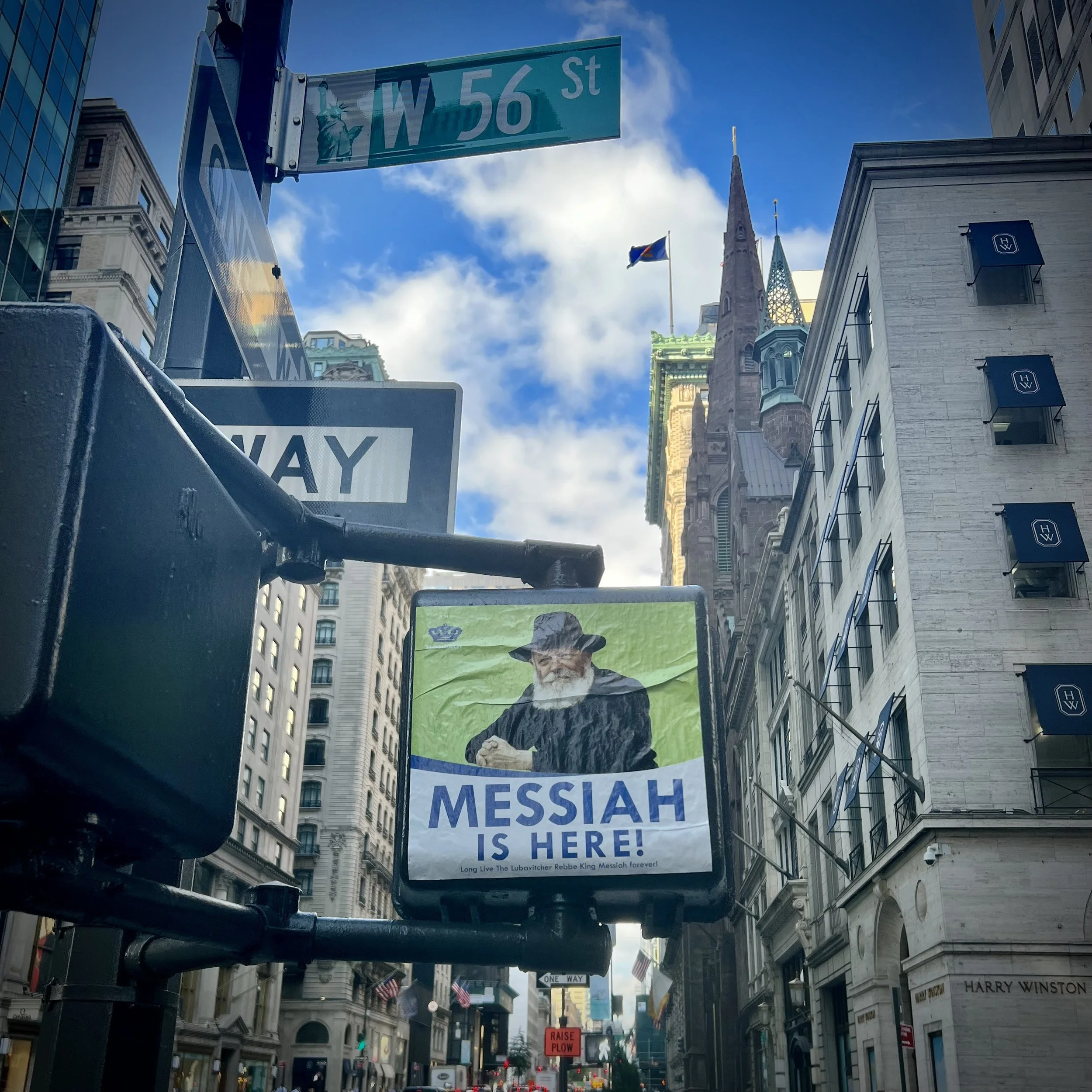
I had preached about Rabbi Shneerson and his familiar Jewish tune, “We want Moshiach Now!” just months before. He died in 1994 and yet somehow here he was back in action. What on earth was going on?
Gopnik explains this was a “reminder of Judaism’s peculiar long-lived legacy” that “losers rule.” Even with the triumphant moment in our reading this morning where Egypt is defeated, God is praised, and the Hebrews are redeemed, Gopnik writes that they “were the great sufferers of the ancient world – persecuted, exiled, catastrophically defeated.”
Gopnik then turns his keyboard to the church. He asks, “How much losing is there, really, in Christianity?” I have a hunch that many of us would argue Christianity is about winning not losing: victory over sin, suffering, evil, death, darkness, and the devil.
And you wouldn’t be wrong,
But you also wouldn’t be entirely right.
Gopnik continues, “the force of the Christian example surely lies in the extremity of the deity’s abasement, tortured to death in the most humiliatingly imaginable way and left to be buried as a criminal.”
In other words: a loser.
The paradox of Christianity is this: victory through defeat, winning through losing, life through death.
Victory is achieved through means measured by a metric radically and unrecognizably different from worldly standards and conventional wisdom.
This is the focus of our readings this morning.
But while the Hebrews are victorious in Exodus, and forgiveness is free-flowing in Matthew, humans are neither the initiators of nor the primary actors in their salvation.
It is God alone who initiates, who acts, who forgives, who wins.
Last week was a presentation of the Passover, the holy night different from all others. Each household was instructed to take a spotless lamb, bring it into their home on the 10th day, and then slaughter it on the 14th. The blood of the lamb was to be smeared on the lintels and door posts, the meat of the lamb eaten in a very specific way:
Hurriedly.
With staff in hand;
Sandals on feet;
And loins girded.
Why? Because this was the night that YHWH would pass over.
It would be a night to remember, holier than all others.
For the Egyptians, however, things did not go so well.
The first born of every household, both human and livestock, were struck down. Families devastated, the economy crippled; it was total defeat. A massive victory for God’s people over God’s enemy, orchestrated by God himself.
Pharaoh is so disheartened and distraught that he finally gives Moses and them permission to get out.
On their way out of Dodge, the Egyptians thrust troves of silver and gold into the hands of the Hebrews, literally paying and blessing God’s people as they leave.
It looks like all has been put to rights and made well…
That is, until Pharaoh’s smoldering anger overcompensates for his sorrow-filled apathy.
He reneges on his promise of freedom.
He readies the chariots and horses and warriors.
He suits up in battle-gear, clothed with blind rage.
He seeks to avenge the people responsible for his grief.
He has no idea that he’s actually going to battle against the living God.
The stage for this cataclysmic clash is set. And for Moses and them, it doesn’t look good. To borrow from George Clooney’s Dapper Dan Man in O Brother Where Art Thou?, they were in a “tight spot.” They were sitting ducks at a dead end with nothing but water surrounding them. These liberated slaves had silver and gold, but they had neither horses nor chariots, neither bows nor arrows, neither swords nor shields.
In fact, they were led by an octogenarian, stick-wielding, Egyptian-murdering, speech-mumbling shepherd.
It was not the vibe.
The Israelites hurl a horrible accusation at Moses:
Did you bring us out here just to kill us in a mass grave?
Israel may be discouraged, Moses dismayed, but God was never distant. He promises to show up, show off, and show out. This is all being done for the glory of his name. Egypt and Pharaoh will soon know that there is only one God and he does not share power.
Our passage finally picks up with the pillar of cloud moving between the Egyptians and Hebrews. The Angel of the Lord assumed the lead at the front of the chosen people; God would guide them to safety with his mighty hand and outstretched arm.
Moses stretches his hand out, but it is almighty and omnipotent YHWH who drives the waters back. The same God who spoke the world into being, who hovered over the waters of the deep, is the very same God who parts the Red Sea and creates a way where there was no way; safe passage on dry ground for his holy people.
You may be seeing Charlton Heston as Moses from Cecil B DeMille’s The Ten Commandments in your mind’s eye. It took production 6 months to set up and shoot the parting of the Red Sea. They used 360,000 gallons of water – more than half of an Olympic-sized pool – and $1 million to shoot the scene in reverse.
Israel had a front row seat to God’s terrific display! No film manipulation or sleight of hand, no computer-generated imagery or AI slop required.
As the Israelites cross over, Pharaoh and his army give chase.
You have to appreciate their dogged determination here.
They’ve watched plagues aplenty.
The bloody Nile, frogs, gnats, flies, livestock, boils, hail, locusts, darkness, and the death of the firstborn.
They witnessed a pillar of cloud by day and fire by night guarding and guiding the procession.
And then they see the Red Sea parted.
And still they follow! How hard had Pharaoh’s heart become!
At God’s command, Moses reaches his hand back over the water and the sea collapses upon the Egyptians. All of Pharaoh’s horses and all of Pharaoh’s men couldn’t put Egypt back together again. It was chaos and commotion, death and destruction, victory and vindication.
Egypt’s catastrophic defeat becomes part of Israel’s narration.
The LORD is a mighty warrior; YHWH is his name…
The chariots of Pharaoh and his army has he hurled into the sea…
With his constant love he led the people he redeemed. (2)
YHWH kept the promise he had made to Abraham several centuries before. When covenanting with Abraham, God gave him a theological peaky-boo of coming attractions: the vastly numerous people of promise would be enslaved in a land not their own for 400 years. But God would hear their cry, see their misery, and turn his face toward them to save them.
Slavery would not have the last word.
False gods and deities would not have the last word.
YHWH would always have the last word.
The children of Abraham, Isaac, and Jacob would return to their promised land. Their story was never going to end in bitter disaster, there was always going to be deliverance.
The Red Sea is the climax of the exodus story. As the waters collapse and flood over Egypt’s army, the Israelites are finally free from their abusive oppressors. The timing may not have been the way that they wanted it…400 years is a very long time…but God delivered plentiful redemption.
The closing of one chapter (slavery) is also the opening of a new chapter (learning to live as God’s redeemed people). This lesson in learning will also last longer than they wanted it. They will learn the hard way by wandering the wilderness for 40 years.
There will be moments when they complain and grumble;
Moments when they long for Egypt with three hots-and-a-cot.
Moments when they reject the covenant and covenant maker.
Moments when they forget their narration.
The Israelites are no different…
Than Adam and Eve passing the blame for their sin in the garden.
Than Peter who looks for an out when it comes to forgiveness.
Than us when we expect a hefty dose of cheap grace and easy fixes.
If we’re being honest, it’s our fallen nature to neglect, reject, or forget the presence of God as we seek loopholes that let us off the hook.
That’s a big sentence. Let me say it again before I unpack it.
It’s our fallen nature to neglect, reject, or forget the presence of God as we seek loopholes that let us off the hook.
When we forget our narration, we are prone to wander from the great and gracious God who made us and who saved us. We see this forgetfulness in Peter’s question and Jesus’ parabolic reply.
Recall our Matthean context...
Matthew 18 is about the internal operations and dispensations of the family of God. Last week’s passage demonstrated that this is not about authority or “church discipline” but rather brothers and sisters mutually caring for one another. Within that context, Peter approaches Jesus with a very loaded question: if my brother or sister sins against me, how often should I forgive?
The emphasis has shifted from the sins of a sibling, generally, to sins committed against me, specifically. And things change when they become personal. Peter supplies his own answer, “As many as seven times?”
This is clever of Peter.
Jewish law required forgiveness three times; Peter doubled the requirement and then added one for good measure.
Smart boy.
Jesus gives a different number: seventy-seven or seventy times seven depending on the translation. The meaning is clear: forgiveness is inexhaustible.
Peter thinks he found a loophole.
But Jesus gives him a parable.
We encounter a man who, like the old commercial, is in debt up to his eyeballs.
The size of the debt was utterly unimaginable. It’s so astronomic and hyperbolic that it is comedic.
“The talent was the highest unit of currency, and ten thousand the highest Greek numeral—‘a billion pounds’ would convey the impression.” (3)
It is roughly equivalent to the salary of 200,000 working years. (4) You can’t math this, but if you could it would be approximately $14 billion. It is debt beyond repayment, beyond comprehension. And it is forgiven. Wiped away. Zeroed to nothing.
On his way home from his bail out, a slave in minor debt to him approaches. Our man shows no mercy, no forgiveness, no kindness. He calls the debt due knowing that it will cripple the man’s family. And if the man is in jail, he can’t work to pay it.
After receiving such lavish generosity, any limitation on the forgiveness from him to his brother is unthinkable. The fact that the second servant’s debt is one six-hundred-thousandth of the first emphasizes the ludicrous impropriety of the forgiven sinner’s standing on his own ‘rights’. (5)
He should have been operating out of his own forgiveness but somewhere along the way he came to believe he was responsible for his redemption. As though he was that slick. How quickly he forgot his own narration!
In the Old Testament, Israel constantly struggled with believing her own press as though she had saved herself.
Israel was not redeemed by her own achievements, accomplishments, or merits. She was redeemed by God because God had identified her as his covenant people.
God is the primary actor, the only savior.
That is her narration: Almighty God with a mighty hand to save.
Likewise, the servant’s forgiveness does not come from spiritual superiority. He is in debt beyond his wildest nightmares.
He is forgiven because the master is gracious.
God is the primary actor, the only savior.
That is our narration: Forgiveness of sins through Christ’s cross.
In both instances, we see that God is the one who provides the way.
He parts the Red Sea and gives safe passage from slavery into freedom.
He forgives sins and gives safe passage from death into life.
New friends, I have bad news and I have good news:
The bad news is that we are morally bankrupt. We are in sin-debt up to our eyeballs and we cannot pay or bail ourselves out.
The good news, though, is that Jesus has paid it all. And you can’t do anything to deserve it! The resurrection means your sins were forgiven on the cross. All you have to do is receive it!
And because we have been so greatly forgiven, we are called to forgive others, no matter how big or small the offense.
If a nation is indeed its narration, what is our narrative?
We live in a world where false gods constantly vie for our attention, affection, and adoration. Money, sex, sports, drugs, alcohol, friendships, politics, platform, prestige, family. They are dangerously seductive. But the story of Scripture, the story of the cross beckons us to come and find our identity through a different narrative: we are a community of the forgiven, a people called to gossip the good news of God’s redeeming love.
The Gospel is good news to the losers and lonely, the downtrodden and depressed, the ragamuffins and rejects, the sinners and sufferers like you and me.
Part of knowing our narration is knowing our part in the story. We don’t get to play Charlton Heston or Moses or Jesus. We are the sinners, ragamuffins, and wayward wretches. We are the redeemed and forgiven who are called to invite others into that very same redemption and forgiveness! We forgive as we’ve been forgiven, we offer Christ’s redemption as we have been redeemed.
We didn’t earn it or deserve it.
You can’t hoard it or hold onto it.
You have to give it away to keep it.
We can’t pay for it or provide it.
But Christ has done it all, already.
And that isn’t just a good story.
It’s the best story. Amen.
NOTES
Gopnik’s book review for The New Yorker can be accessed here.
To the astute listener, these three lines are taken from the “Song of Moses (Miriam)” or Canticle 8.
R. T. France, Matthew: An Introduction and Commentary, vol. 1, Tyndale New Testament Commentaries (Downers Grove, IL: InterVarsity Press, 1985), 280.
At an annual US salary of about $69,846.57, 200,000 years of wages comes to $13,969,314,000 — about $14 billion.
R. T. France, Matthew: An Introduction and Commentary, vol. 1, Tyndale New Testament Commentaries (Downers Grove, IL: InterVarsity Press, 1985), 280–281.