
Sermon: Masters of Mercy
This sermon was originally preached at St. John's Episcopal Church in Columbia, SC on Sunday, August 16, 2026. The lectionary texts for the day were from Proper 15A (Track 2): Isaiah 56:1,6-8; Psalm 67; Romans 11:1-2a, 29-32; Matthew 15:10-28.
Masters of Mercy
I want to start off by playing a game…
By a show of hands, how many of you own a television?
How about a computer?
A tablet?
A smart phone?
Good, so that’s (almost) everyone and most with multiple devices.
Here’s the problem: 49 hours.
49 hours is the average amount of time you spent this week consuming digital content before you came to church.
Not just some of us.
All of us.
How are you spending those 49 hours?
It might be reels from the Savannah Bananas or preparing for your fantasy football draft. Maybe news from your preferred outlet or doomsday scrolling on your favorite app.
We fill our 49 hours with distraction, comparison, outrage, self-curation, anxiety, escape, or simply attention without presence.
Digital formation in an age of information is a rough place to be.
Experts say it takes 10,000 hours to master something.
10,000 hours to master your backswing.
To master the art of French cooking.
To master the craft of preaching.
With 49 hours a week it will take you just under 4 years to hit your 10,000 hours becoming experts in digital consumption. We are effectively earning a master’s degree in reels-watching, armchair-quarterbacking, political hot-taking, and cat-meme-ing.
But be ye not afraid, my new friends.
This isn’t a sermon about the dangers of iPhones and technology. That much is already assumed. Instead, this is a sermon about what it means to master something with prodigious proficiency.
Today’s passages show us the arc of salvation, the metrics of God’s mission, the gradient of his grace.
We are being invited to become masters of mercy.
The real meat of our Gospel reading is found in Jesus’ encounter with the Canaanite woman. To get to that point, however, we have to wrestle with the first 20 verses of chapter 15: both his words to the Pharisees and the crowd. The lectionary compilers decided to exclude these verses in the name of brevity despite their obvious clarity. This is why we don’t start stories in the middle.
We’re going to quickly work through verses 1-9, we’ll slow down a smidge for verses 10-19, and then we will sit with verses 20-28 for a long-er while.
At the beginning of Matthew 15, Jesus is accosted by the Pharisees on account that his disciples do not acclaim the tradition of the elders. That is, they do not wash their hands before they eat. Without pausing to consider whether this is culinarily sanitary, we have to understand that it is ceremoniallyarbitrary.
There are Traditions with a capital-T and then there are traditions with a lower-case t. The washing of hands before eating was a lower-case t tradition. Jesus calls the Pharisees out for superimposing manmade mandates, ridiculous rules, and superfluous superstitions upon the people of God, thus nullifying the word of God.
Later in Matthew, Jesus will take the Pharisees to task again. This time he will give the religious-legal leaders a series of woes while calling them “whitewashed tombs,” “blind guides,” and “hypocrites” because they demand others do more than they do.
The Pharisees have placed the wrong emPHAsis on the wrong syLLAble. Instead of mastering the word of God, they have mastered mundane minutiae.
This is why Jesus talks to the crowd about what goes into the body and whether or not it defiles.
In computer science, this is known as garbage in, garbage out. It seems rather obvious, doesn’t it? If what goes up must come down, then what goes in must come out. But Jesus turns the conversation on its head, focusing on the heart habits of consumption and production, rather than food and waste.
It’s not what goes in the body, but what comes out of the mouth.
New friends, I’ve got bad news for you: the heart is not a trustworthy guide. Our Lord would never tell someone to “just follow your heart.” The heart can be the seat of malice, lying, evil intentions, lust, murder, and more. It is fickle and feckless. But through the power of the Holy Spirit, hearts on fire with the love of Christ can overflow to the praise and proclamation of their mouths.
And all of this, the Pharisees’ complaints and Jesus’ teaching on what defiles, leads us to the Canaanite woman. If we neglect these two scenes, choosing to ignore them altogether or glossing over them for any reason, we water this encounter down to merely a Jew and Gentile quibbling and quarreling over breadcrumbs.
Jesus left the crowd and Pharisees behind and traveled to the region of Tyre and Sidon.
We have to stop.
These names are significant.
They describe towns historically and bitterly opposed to Israel. It would be like someone traveling away from the land of garnet and black (USC) to the godforsaken land of orange and purple (Clemson)...it was that bad!
Sidon was where the father of the godless and idolatrous Queen Jezebel reigned as king. Jesus isn't merely going into another county…he’s going behind enemy lines. And Matthew’s Jewish audience would have understood the implications immediately.
Behind enemy lines, where no God-fearing Jew should go, Jesus is approached…
By a woman.
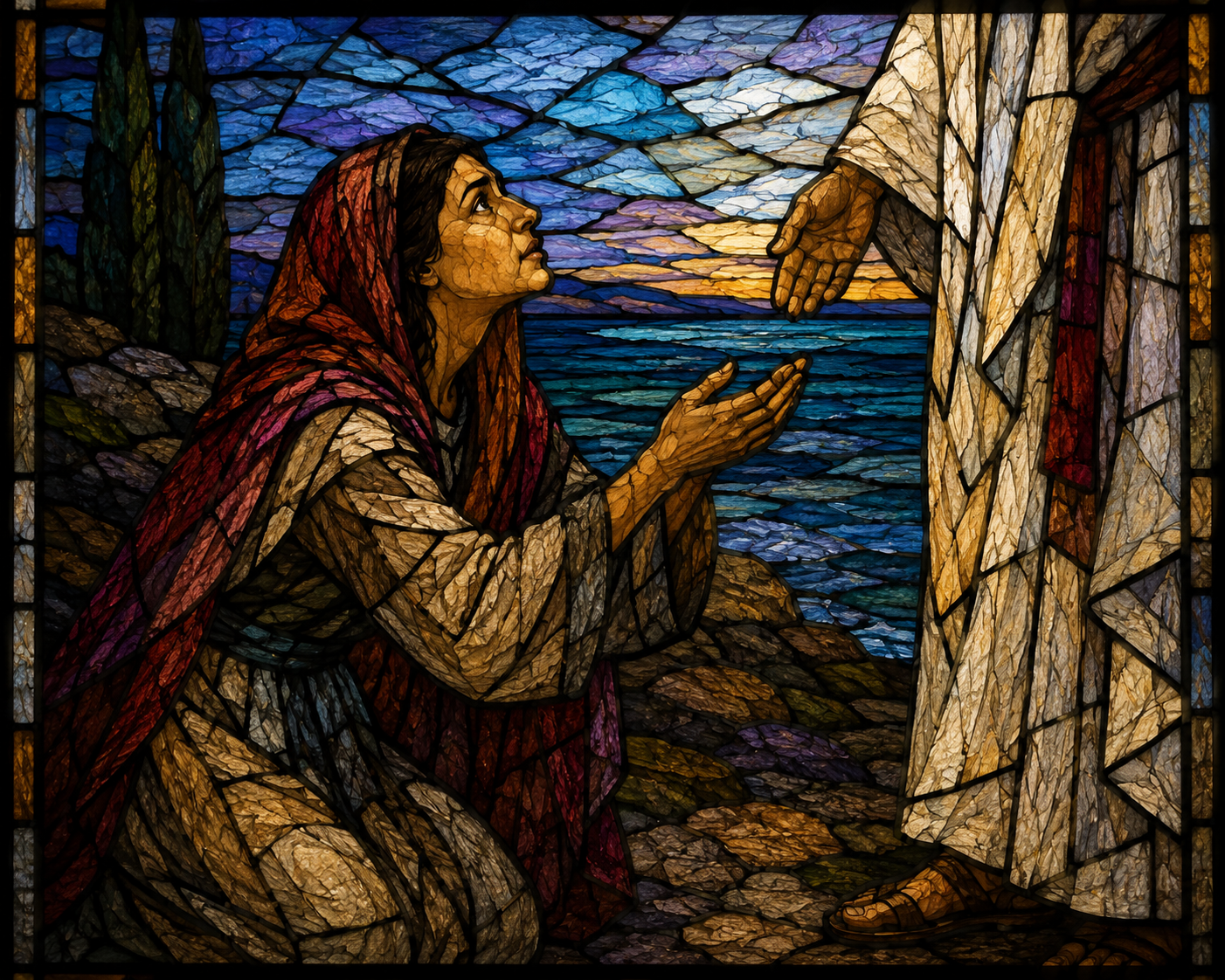
By a Canaanite woman.
By a Canaanite woman whose daughter was possessed by a demon.
This is the triple whammy of uncleanliness.
Anyone in their right mind would expect Jesus to leave. If the Pharisees were troubled by the disciples not washing their hands, they would have been clutching their pearls by this point.
And that’s the point of the story, by the way.
This nameless, godless, status-less woman is identified only by her country. The Canaanites were those who inhabited the Promised Land before Israel took possession. They were not worshippers of YHWH, they were not considered clean, and they were not part of the house of Israel.
And yet this woman knows Jesus.
Not from 49 hours of TV or social media.
She knows him by name and by title.
Can you imagine it? A Gentile referring to Jesus as Lord and Son of David. These are imperial and messianic titles. They matter.
She knows precisely who Jesus is.
In fact, she understands his identity better than the Pharisees.
That should stop us in our tracks…
Jesus is doing something different here.
The Kingdom of God operates according to a different logic than the rest of the world. When Jesus is Lord, things are topsy-turvy, upside down and god-side up.
She comes to Jesus pleading for help, knowing he alone has the power to rid her daughter of her demonic tormenter. We aren’t told how long she has been afflicted, but we can assume that she is hanging on by a thread. She’s at the end of her rope with the realization that she needs divine intervention to overcome her human limitations.
You may be in that space right now.
You don’t have to be a Canaanite to be at the end of your rope.
You may be here this morning tired and tight-lipped over the start of the school year;
You may be weary, worried, and worn out from health concerns or the news cycle;
You may be dealing with anger, angst, or anxiety because things are out of your control.
I don’t presume to know your circumstances, but I do know that the Lord is there to pick you up at the precise point where your human power is limited. That doesn’t guarantee healing or change of circumstances, but it is the promise of his powerful and peaceful presence.
The disciples want Jesus to wash his hands of the situation (Pharisaical pun intended). They know their teacher and Lord should not be here. For them, Jesus needs to get out of triply unclean Dodge as quickly as possible.
In his reply, Jesus states that he was sent to the lost sheep of the house of Israel. She is a lost sheep but of a different house and in this moment that matters.
I can’t unpack that any further until we go a little farther.
She again calls him Lord and pleads for his help. After this somewhat comical back-and-forth, Jesus replies to her directly: It is not fair to take the children’s food and throw it to the dogs.
The food referenced is the good news of God’s reign and rule.
The children are the lost sheep of Israel.
And the dogs…well it’s the Canaanites. The woman.
The Gentiles. You and me.
You may be feeling uncomfortable by this point. Did Jesus really just call her a dog? The short answer is yes. The longer answer is that this was language both the Jews and the Gentiles were used to. He is meeting her at the intersection of conventional wisdom and societal niceties to explain that in the hierarchy of eating, the dogs went last. As Andrew McGowan reminds us, there was a hierarchy of eating in the ancient world.
And this is where context matters.
It’s not that the dogs didn’t get food at all. Jesus isn’t suggesting that the dogs should starve and stay away from the table. But rather that the dogs eat the scraps at the appropriate and appointed time once the meal is over.
The woman understands this. Immediately. Intrinsically. That’s why she replies about the dogs eating the crumbs at the master’s table. This Canaanite woman, the very one who called Jesus Lord and Son of David, understands that the living God of Israel is the master of the table and she is ready to eat the crumbs. This is a pronouncement of faith even if it comes in the form of culinary purification language!
The Canaanite woman shows us the what if of God’s Kingdom, a theological peaky-boo of coming attractions.
Jesus has announced that the merciful news of salvation is coming to the dogs after the lost sheep of Israel, but she wants in on it now. And she gets it. Her persistent, pesky faith results in the healing of her daughter and salvation coming to a Gentile.
The Pharisees would be agog and aghast, but we should not be. The promise of salvation extending beyond the boundaries of Israel is something we find again and again in the Old Testament.
It shows up first in Genesis 12 when God first spoke to Abraham and told him that the nations of the world would be blessed through him. We see it even more explicitly in our passage from Isaiah. The prophet writes:
Thus says the LordGod,
who gathers the outcasts of Israel,
I will gather others to them
besides those already gathered.
The outcasts and outsiders,
The sinners and the ain’t-never-been-no-winners,
The foreigners and the forgotten;
The downcast and the downtrodden;
The little, the last, the least, the lost, and the lowly;
They are all being gathered into Israel alongside Israel by the God of Israel!
Matthew has been telegraphing this from the beginning of his gospel when he listed Gentiles and women in Jesus’ genealogy. At the end of Matthew, just before Jesus ascends to the right hand of the Father, he sends his apostles to make disciples of all nations.
And in Matthew 15, in this wild story about crumbs and dogs, the good news has reached the ends of the earth early. And there is good news in that for all of us:
The Canaanite woman gets in;
The Gentiles get in;
The tax collectors, sinners, prostitutes, and even the Clemson fans get in.
You and I get in.
Salvation is not based on birthright or handwashing, but based on faith in Christ and Christ alone.
When we reduce Matthew 15 to matters of ethnicity, estate, or etiquette, we miss the salvation which God graciously and mercifully bestows to the house of Israel and to Gentiles.
Even with all of this talk about good news for the Gentiles, Paul reminds us that God has not rejected his people Israel. The Church does not replace Israel. Instead, we are adopted into the family of God, grafted as a branch onto the stump of Jesse.
Because in Christ, God’s mercy will be shown to all. The grace of God is irrevocable and the mercy of God is intractable. God’s salvation has come, is coming, and will come to any and all who call upon his name.
And those who are in Christ are called to be masters of mercy.
What does it look like to become masters of mercy when we are faced with the unending onslaught of online and on-screen distractions?
We can begin by repurposing our 49 hours of digital consumption by realigning them around digital discipleship.
Instead of spending 10,000 hours mastering memes and media, we can transform that time into reading Scripture, praying the Daily Office, listening to sermons, participating in Bible studies, and so much more. Not that we may score religious brownie points or earn our salvation, because we can’t, but to be formed more into Christ’s likeness, to let our hearts and minds be transformed by the Holy Spirit, allowing praise to well up in our hearts and overflow out of our mouths.
Beyond that, however, we are invited to be merciful as God is merciful and to whom God is merciful…and as I have shown you this morning through our lections, that means all people. The good news about the Good News is that there is no fine print or blackout dates, no terms or conditions which may apply.
It is good news because it is freely given.
To become masters of mercy means being prodigiously proficient in giving grace, sharing salvation, and gossiping the gospel.
When we have experienced and encountered the magnificent mercy of Almighty God, we are compelled to tell everyone we know all about it.
The Canaanite woman would have told her friends, family, and formerly-demon possessed daughter about Jesus.
The Gerasene Demoniac went to the Decapolis preaching.
The women who found the tomb empty ran to tell the disciples.
You are the Canaanite woman.
You are the Gentile.
You are the outsider who has been gathered.
You have eaten from a table to which you had no natural claim.
You live by mercy.
Now go and gossip the good news you have received as a master of mercy. Amen.