
From the Archives: Further Up, Further In
This sermon was originally preached on Sunday, October 3rd 2023 at St. David’s by the Sea in Cocoa Beach, FL where I served as rector. The lectionary texts were those appointed for Proper 22A - Track 1: Exodus 20:1-4, 7-9, 12-20; Psalm 19; Philippians 3:4b-14; Matthew 21:33-46 .
This is a sermon from my archives. If you are deep in sermon prep, looking for something to read before writing for this Sunday, or simply reading along as a parishioner, I pray this oldie will be a blessing. Each Tuesday, I’ll share an old sermon for the coming Sunday in the hope that it might serve preachers and parishioners alike.
Further Up and Further In
In his beloved children’s series, C.S. Lewis chronicles the origins and history of a mythical land called Narnia. The foundations of Narnia are teeming with magic as Aslan the Lion sings the land into being.
While most of us know of Narnia through Lewis’ most famous book in the series, The Lion, the Witch, and the Wardrobe, the whole tale focuses on an epic battle between the forces of good – represented by the lion king Aslan – and evil – depicted by the White Witch.
As with every quality saga, the fight between good and evil comes to a final head in the ultimate book of the series, appropriately titled, The Last Battle. After defeating his enemies and saving his people, King Aslan the lion announces that Narnia has served its purpose and will be going away.
This is not the end, however, but only the beginning.
A new and more glorious Narnia is about to appear and the Narnians will be ushered into a new age, a better age, an age when Aslan is still King and a land where peace and harmony, love and mercy, beauty and goodness, justice and grace overflow. As the new Narnia takes shape in front of them, a quote from Jewel the unicorn, beautifully captures the general feeling of the moment.
“I have come home at last! This is my real country! I belong here. This is the land I have been looking for all my life, though I never knew it till now. The reason why we loved the old Narnia is that it sometimes looked a little like this. Come further up, come further in!”
Further up and further in.
And this isn’t the only time the phrase is used. Aslan beckons the Pevensie children further up and further in every time they enter Narnia. Farsight, Reepicheep, and Mr. Tumnus similarly talk about going further up and further in.
Everytime someone is told to go further up and further in, it is a holy, gracious invitation to discover the Really Real Reality of the world. It is a summons to a deeper commitment, a beckoning to a more steadfast and robust participation in God’s kingdom.
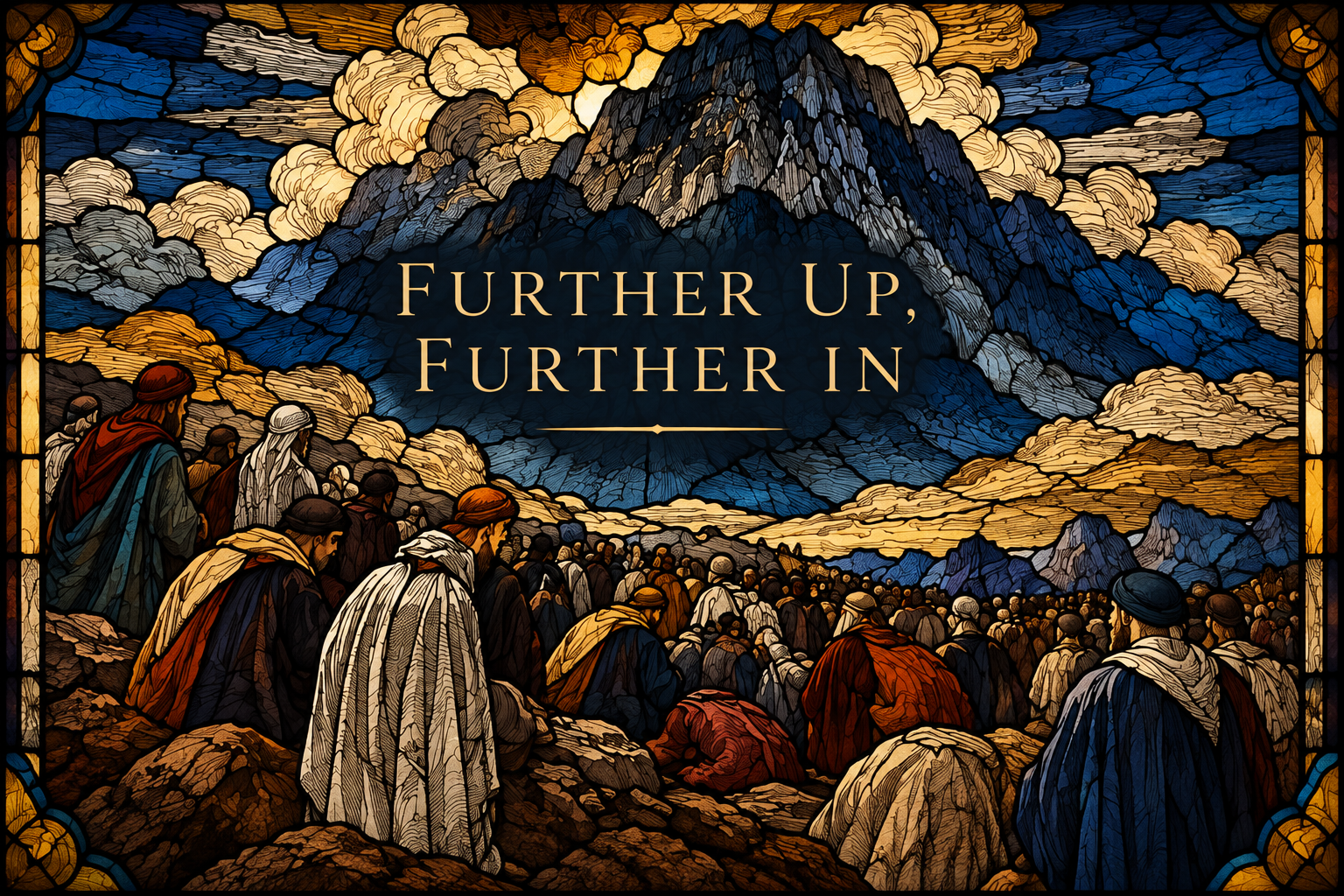
And that is where we find ourselves this morning. We are at the foot of Mount Sinai with Israel as she receives the law and we find ourselves at the feet of Jesus as he tells a parable about kingdom life.
This morning we are being called further up and further in.
The Israelites have finally made it to Mount Sinai after a month and a half of wandering. This is actually the second time that the Exodus story has landed at Sinai. The first time was back in Exodus 3 as Moses was taking his father-in-law’s flock out for a walk. While he was walking there, he encountered the burning bush, alight with a fire that did not consume. As a sign that he would be with Moses, YHWH promises Moses that his people, God’s people, will be brought right back to this place to worship him.
The people of God have been enslaved for over 400 years. Egypt was a highly advanced civilization and Pharaoh wielded a significant amount of authority. And a burning bush tells a rural shepherd that he will lead this massive mass of humanity out of the clutches of the oppressor and into the countryside for a revival and hymn-sing.
Amazingly, and against all rational odds, Moses believes this awesome and audacious announcement.
Moses is finally back near his old shepherding grounds with his flock in tow. This time, however, his flock is not ovine with cloven hooves, but the flock of God’s chosen people, the people of the covenant.
God has fulfilled his word. We are reminded, yet again, of an essential truth: our promise-making God is also our promise-keeping God; he is who he says he is and he will accomplish all that he has promised.
In chapter 19, the Israelites consecrate themselves, setting themselves apart as clean and holy. Israel is told to assemble at the base of the mountain, awaiting God’s terrifying and overwhelming presence. And it is after this consecration that God addresses his people.
Most pastors, priests, and preachers skip right over verse 2 and go directly to verse 3. To ignore verse 2 is to miss the point of this chapter entirely. We have two interpretive options this morning and like Frost’s road diverging in the wood it matters which road we pick.
Our first option, the more popular option, overlooks verse 2. This option views the 10 Commandments as a set of divine prohibitions and restrictions from a cosmic killjoy looking to spoil our fun.
When we go this route, we’re left with the inevitable and erroneous idea that if we can somehow keep the law then we will earn redemption. If only I can do enough or be good enough then God will love and save me. We are all too willing to buy into this pedantic and petty version of God.
But this is not the heart of God demonstrated throughout Scripture.
The second option, the better option, is to read the 10 Commandments within the context of verse 2. Why on earth is verse 2 so important, you ask?
In verse 2, God tells his people precisely who he is! He reminds them that he has brought them out of Egypt, that he has ended their slavery, that he is their God, that they are his people. The law is given to a people already redeemed! Deliverance has already happened! God has already saved his people by his mighty hand and outstretched arm.
If the people are already saved, delivered, and redeemed then what is the purpose of the law?
It’s a holy summons further up and further in.
The law represents the fenceposts around the pasture where God and his people will dwell, graze, and live together. The law is the bumper rails at the bowling alley to help the young and inexperienced keep their bowling balls out of the gutter. God gives his people the law as a means of saying, “Because you are already redeemed, this is how we are going to live together.” The law presumes a pre-existing relationship between God and his people, between the Redeemer and the redeemed.
Do you understand now why verse 2 is so important and why the first road must always, always be rejected in favor of the second?
And to borrow from Frost, yet again, the choice has made all of the difference.
The first four commandments focus on Israel’s relationship with God. How is Israel to live with the Redeemer? There are to be no gods before YHWH, no idols, no taking the LORD’s name in vain, and always keeping the sabbath holy.
We live in a world of idols and idolatry. Whether it is American Idol or striving for the right house or car or the American Express black card; whether it is our obsession with musicians, athletes, popstars, politicians, or culture leaders; whether it is the bottle of alcohol or pills, or the popularity that comes from being universally liked, we constantly and consistently ascribe worth and honor to someone or something other than God.
What are the idols in your life?
Not everything looks like a golden calf. And yet we give admiration, authority, and attention to the very things that will not save, that cannot save, and we turn our backs on God when we do so. As we will find out in the books of One and Two Kings and One and Two Chronicles, we are called to tear down the altars and idols in our lives and return to the One and Only God, the God who is Really Real.
The remaining six commandments highlight our relationship with one another. We would be foolish to think that we can keep our relationship with God separate from our ethics, how we treat others. Christianity is not a private and personal affair, nor is it to be kept quiet as we keep our heads down and our opinions to ourselves. Instead, the relationships between redeemed people and between redeemed people and the world are to be pleasing and glorifying to the Redeemer.
Adultery, murder, grumbling, disrespect, lying, cheating, covetousness, pornography, racism, sexism, gossip, and everything else prohibited in Scripture are not pleasing to God. Here’s the kicker: We avoid these things not because we think by doing so we will get a better place at the eschatological banquet table. Rather, we are to cast out and reject such behavior because that is not how redeemed people are to live.
Understanding the law through this lens means that we won’t inadvertently turn the law into a golden calf or false god; it means that we won’t try to earn our salvation through holy living and civic do-gooding. The invitation further up and further in is an invitation to live our lives in alignment with God’s will because of all that he has done for us. Further up and further in means that we submit our lives, the whole of who we are, and all that we have – time, talent, and treasures – to the Lord of lords and King of kings.
But that’s just Exodus. What does Matthew have to say about moving further up and further in?
Picking up from last week, Jesus has entered Jerusalem in triumph just days before this and his death is only days around the corner. Jesus has just finished giving the parable of the two sons to the chief priests after they questioned Jesus’ authority for cleansing the Temple and teaching the people.
Jesus moves straight into another parable. This one is called “The Parable of the Wicked Tenants” and if the first one stunned the chief priests into silence, this one will leave them feeling incensed.
A landowner planted a vineyard, put a fence around it, dug a winepress, and built a watch tower. This was a massive undertaking, both financially and physically, as it would be at least four years before any return on the investment was realized.
Our landowner leased his vineyard to tenants before leaving town. This was a common practice in the ancient near east. The landowner and the tenants would have entered into a contractual agreement with terms and conditions. The tenants would be responsible for the upkeep of the vineyard and they would be afforded to keep some of the profit, but the lion’s share would belong to the owner.
God’s relationship with Israel was often referred to with vineyard language. The goal of any vineyard is to produce good grapes to make good wine to sell for a good price so all can have a good time. Vineyards are to abound in fruitfulness, but that is not always the case. Isaiah 5 describes the disappointment of a fruitless vineyard. Our parable describes another disappointing vineyard but this time it is the tenants who have failed. Jesus’ hearers would have understood that the vineyard represented Israel and the tenants symbolized the religious leaders.
At the harvest time – likely four years into the relationship – the tenants decided that they didn’t like terms they had agreed to. Rather than giving the landowner his cut, they are overcome by greed. They decide to beat the landowner’s servants; one is beaten, one is killed, and another stoned. These servants represent Israel’s prophets: as tradition has it, Jeremiah was beaten and it is believed that he was stoned, Isaiah was sawn in two, Ezekiel was killed, and John the Baptizer was beheaded.
The landowner thus decides to send his son and the tenants see their chance. In their greed, they think that if they kill the heir then the land will be theirs. So they seize him, take him out of the vineyard, and kill him. Jesus is that son!
The Father has twice called Jesus “Son” at his baptism and transfiguration and then Jesus uses the term himself in chapter 17. At his trial, Caiaphas the high priest will accuse Jesus of claiming to be the Son of God. Sonship matters!
The chief priests do the very thing that caused them so much offense when they heard it: They seize Jesus, take him outside the city, and kill him. The rejected son is also the rejected cornerstone.
Jesus then asks the non-rhetorical question: how will the landowner respond when he comes? They answer: He will take the vineyard away from the original tenants and give it to others.
The vineyard will no longer belong to the chief priests, elders, and scribes. I want to be sensitive here: it is not to be taken away from Israel but from those who refuse to serve God.
To whom will it be given? To a new people including faithful Jews and Gentiles, to the exact wrong kind of people: prostitutes, tax collectors, gentiles, the truly unclean and unsavory types. And why these people? Because they are producing the fruits of the kingdom! Vineyards are designed to produce fruit! Membership is based solely on the acceptance of God’s redeeming work. As a result of such grace, the redeemed will believe, belong, and behave with fruitfulness.
The hearers of this parable were being called further up and further in. While the chief priests pronounced their own condemnation, the choice was ever before them to align their lives with Jesus and his coming kingdom. And those who were already bearing fruit worthy of repentance, those who were already showing and growing in gospel fruitfulness, were being invited in an even deeper relationship.
And that right there is our call further up and further in.
The Christian life, the redeemed life of salvation, is not about resting on our laurels or sitting on our blessed assurance. It is not about counting our blessings while people suffer around the world or by sitting back and turning a blind eye, mute mouth, and deaf ear to the problems, wrongs, and evils of this world. The Christian life is not about believing that all of the right people already belong to this church or the Kingdom.
The Christian life is a hope-filled, joy-filled, gratitude-laden response to the summons to go further up, further in.
It is a call to a deeper discipleship.
Paul describes this for us in Philippians. After pointing out all of his reasons for boasting–he came from the right family in the right zip code in the right school system with the right friends and the right bank account…and yet all of it meant nothing compared to Christ! He counted it all as loss compared to knowing Christ as Lord. Paul encourages us to strive for the heavenly call of God in Christ! Paul is calling us further up and further in!
I recently read (in 2023) that 2 out of 5 Christians are not discipled, that is, not investing in spiritual growth and their relationship with Jesus. 2 out of 5. True discipleship looks like following Jesus no matter the cost, counting everything outside of Jesus as loss, and devoting the whole of our lives to Christ and his kingdom. Friends, the redeemed people of God are to live as aliens.
God is calling you, me, us, further up and further in in our discipleship. We are being invited to “forget what lies behind and strain forward to what lies ahead, by pressing on toward the goal, toward the prize of the heavenly call of God in Christ Jesus.”
This holy summons is to a closer walk with Christ, to a life more steadfastly aligned with his will and his kingdom, to a deeper commitment to discipleship.
Friends, come further up, come further in!