
From the Archive: Idols, Invitations, and the Immortal
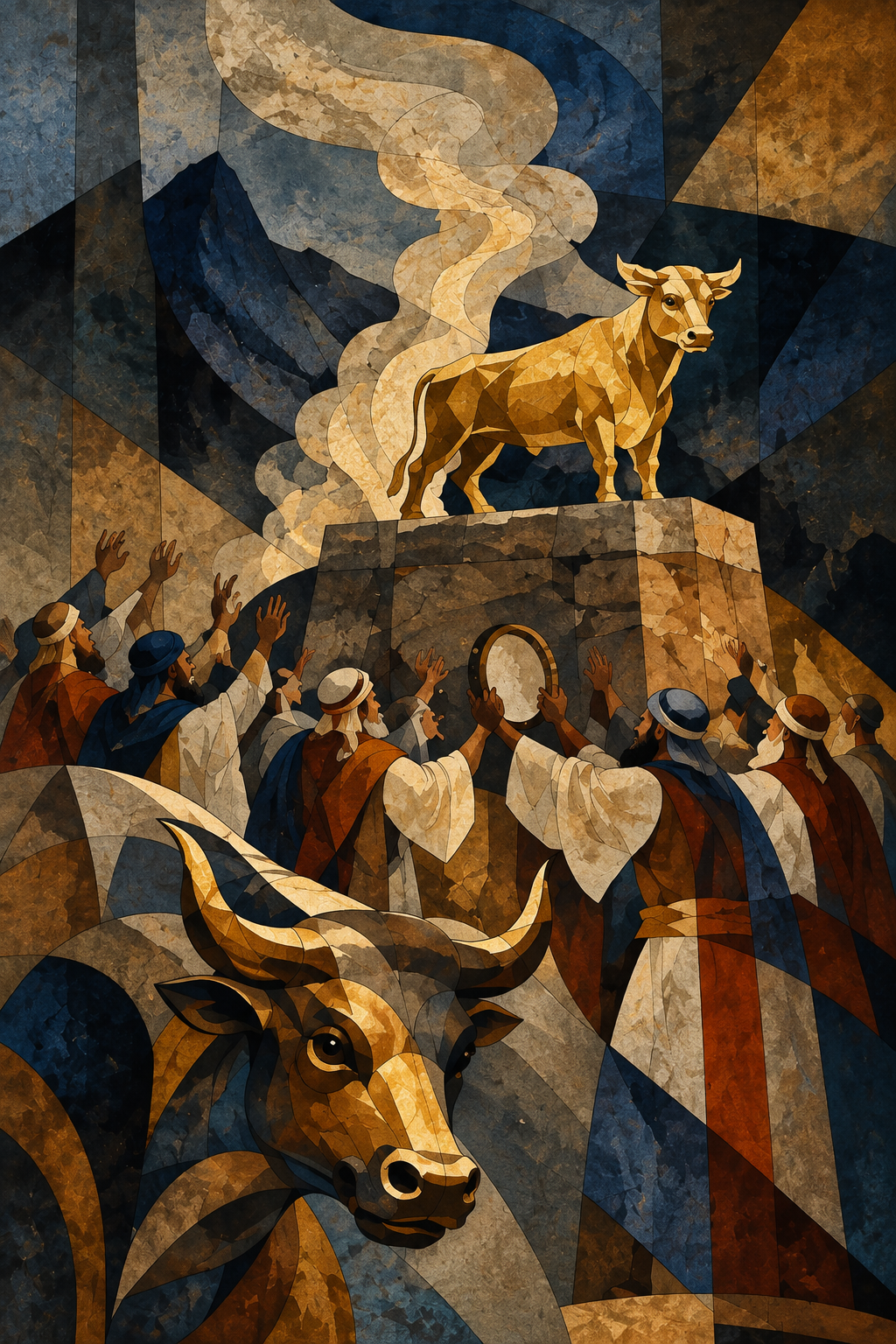
A version of this sermon was originally preached at St. David’s by the Sea in Cocoa Beach, FL on Sunday, October 15, 2023. The occasion was Proper 23A and the texts for Track 1 were: Exodus 32:1-14; Psalm 106:1-6, 19-23; Philippians 4:1-9; Matthew 22:1-14.
This is a sermon from my archives. If you are deep in sermon prep, looking for something to read before writing for this Sunday, or simply reading along as a parishioner, I pray this oldie will be a blessing. Each Tuesday, I’ll share an old sermon for the coming Sunday in the hope that it might serve preachers and parishioners alike.
Idols, Invitations, and the Immortal
In the early hours of December 15, 1989, a flat-bed truck pulled onto Broad Street in Manhattan. The driver and his companions placed a gift under the giant Christmas Tree in front of the New York Stock Exchange. Among them was Arturo di Modica, an Italian sculptor who had moved to America in the 70’s. Di Modica was expressing his gratitude for being accepted and supported in this country, especially after the 1987 Stock Market crash.
Costing Di Modica $360,000 to make and cast in a foundry in Brooklyn, the resulting sculpture was 11 feet tall, weighing 7,100 pounds.
Its name? The Charging Bull.
Just two years after the market’s collapse, Americans hoped for a bull market, a rising tide to lift all ships. Di Modica tried to capture this with his creation.
Intended as a gift symbolizing the “power of the American people,” and “prosperity and strength,” the Charging Bull was not well-received by Wall Street. In fact, the authorities were called immediately and the bull was impounded that very day. Despite its short cameo, the bull’s removal sparked a public outcry. Ultimately, Parks and Recreation relocated the sculpture two blocks away from its original site.
During our trip to New York in June 2022, Rebecca and I walked up Broadway to Trinity Episcopal Church Wall Street. To be clear, we weren’t going to see Trinity as much as we were going to see Alexander Hamilton’s gravesite. Werk!
Hundreds of spectators, onlookers, and tourists were waiting to have their pictures taken in front of the famous sculpture.
There’s an urban legend that if you rub – ahem, how should I put this? – the backside of the bull, you will have a positive financial forecast for the day.
It was a spectacle to behold;
Pilgrims paid homage;
An invitation to admire or to worship.
A visible icon symbolizing an invisible quality.
In Scripture, there is only one word for this: idolatry. I can say this with certainty because that is the scene in Exodus 32.
Moses and the Israelites made it safely to Mt. Sinai where they were consecrated (meaning, set apart) as YHWH’s redeemed people. The law was first given verbally by the voice of YHWH and known as the “ten words” before ever being called the two tablets. The people were so afraid of YHWH’s presence that they wanted a middleman, so they asked Moses to speak directly to him.
After the law was given, Moses went up Mt Sinai for a chat with God.
He was gone longer than expected, however, and the people began to panic with an anxious distrust.
You know that feeling when someone is slightly late but you have them in a ditch somewhere. And they couldn’t text and ask, “Hey Mose, when are you coming back?” He forgot to turn “Find My Phone” on and his Apple tags were back in his tent.
So the people do what they are best at: the grumble about Moses and God yet again. The Israelites then act out of fear.
Fear may be a good motivator, but fear is never a trustworthy companion. Gripped by this fear, they demand that Aaron make gods who will go before them. Why? Because they don’t know what happened to their leader who brought them up out of Egypt.
The people are certain that he has abandoned them. Paradoxically, they both write him off as an absentee ne’er-do-well and credit him with the Exodus, rather than God. Ignoring God’s powerful provision, the people will soon reject his promise and presence.
Israel turns to Aaron, the presumptive #2, and present their complaints to him. Curiously, they refer to “gods” in the plural rather than the singular. Israel had recently heard the voice of the one God saying they shall have no other gods. This event would have been etched in their memory because they were so afraid of God’s presence, of his utter holiness, and yet they quickly requested different gods.
Ironically, they wanted gods who would go before them. This is how we know that they aren’t asking for YHWH because he has been going before them for the last two months! Pillar of cloud by day and fire by night, consuming presence, water from the rock, bread from heaven. Their God has been going before them, but they want something different.
Israel wanted images of their new gods. Their God, the God of Abaraham, Isaac, Jacob, and Moses was invisible. The living God could be seen through fire and cloud, plague, passover and parting the sea, but the people wanted something they could look at. In their short-sighted haste, they trade the invisible for the visible, the one true God for a false idol, the omnipotent for the impotent.
The true paradox here is that Aaron is not the leader-in-waiting! There is no succession plan including Aaron’s name at the top of the list. In fact, Moses has just recently appointed Aaron, Hur, and 70 elders to share in the ministry of leadership. Aaron should have told this grumbling group of people “no” and consulted with his fellow leaders, but in a moment of weakness, insecurity, and ambition, Aaron grasps the mantle of leadership without possessing any actual authority. He capitulates and accommodates the peoples’ sinful, god-forsaking, Moses-neglecting requests without as much as a feeble protest.
Aaron’s best thinking is to have the people turn in their gold. This is the very same gold their Egyptian enslavers gave them as they were leaving town. This is the very God-given gift from plundering Egypt.
God’s gift is melted into a molten-idol.
They worship the gift rather than the Gift Giver.
And not just any idol. He turns it into a golden bull. The word actually means “a young bull in his first strength” and can indicate a bull of up to three years old. We’ve already talked about a bronze bull this morning as a symbol of financial strength and prosperity, but this takes the cake.
Do you remember the false god, Baal?
The Canaanites and others depicted Baal as a bull. Baal worship was among the worst idolatry in the Old Testament. Remember, Exodus is written by scribes while Israel is in exile because…wait for it…she had rejected her God and worshiped false gods like Baal. While there is no proof that Israel wanted to worship Baal at this moment, this is at best a sad irony and at worst a horrifying betrayal.
Aaron fashions a golden bull and then proclaims, “There are your gods, O Israel, who brought you up out of the land of Egypt.” Aaron is using the plural for god, again, but he is doing so with reference to what YHWH has done for his people. Perhaps in an attempt to redeem the situation, Aaron only makes it worse by taking the LORD’s name in vain and applying it to an inanimate object.
Israel broke the first three commandments in rapid succession. This is what happens when we give into our sinful desires and bad behaviors. “Their use of the gold contradicted the redeeming work of the Lord, as represented by the tabernacle; the making of the image contradicted his word; and calling it by his name contradicted his revealed nature. The people had exchanged the invisible God who had led them by his spoken word for a visible ‘thing’ which could not speak.”
We need to dig deeper into our own hearts.
We consistently erect idols in our hearts, in our minds, in our lives.
We bow down and worship false gods, graven images, inanimate idols.
We trade the immortal, invisible for the visible and visually appealing.
And we need to confess.
We need to repent.
We need to tear down the altars in our hearts.
In 2 Kings 23, you will find a thick description of how King Josiah restored right worship in Judah by destroying the altars, idols, and high places. May the Spirit enable us to do the same!
Instead of confessing their sins before God, Aaron builds an altar and sets the next day aside as a festival to the LORD.
During this festival they eat, drink, and then they “rise up and play,” a phrase that may function as a euphemism for a ritualistic orgy.
Commandments are broken;
God’s name is yet again profaned;
Humanity is degraded;
Hedonistic pleasure is celebrated.
Israel is shattering her covenantal relationship with YHWH in the name of religious celebration!
Meanwhile, Moses is meeting with YHWH atop Mt. Sinai.
As the revelry unfolds, YHWH tells Moses to get back down there. Notice that God does not refer to the people as his people but as Moses’. God then refers to the people as “stiff-necked.”
My guess is that most of us don’t know what it means to be stiff-necked, unless you grew up on a farm.
Stiff-necked-edness refers to an ox or horse that won’t respond to the rope when tugged. Imagine riding your horse and it won’t respond to your pull upon the reins, even with the bit and bridle firmly in place. To be stiff-necked is to be extremely stubborn.
And this is where our passage gets tricky.
Alongside Matthew 22, this is one of the “tough passages” in scripture because it would appear that God is disowning the people after they have disowned him. What we have to remember, though, is that while all Scripture is inspired, there are still human limitations at play. Too often we discover what is known as anthropopathism which is a really fancy word for applying human emotions to God. The writers of Exodus are seeking to use an analogy to explain the unexplainable.
Did Moses change God’s mind? No, of course not.
Did Moses remind God of the covenant and God chose to go in a different direction? Yes!
God is still keeping his covenant though he had every right to let his anger burn hot. He is still steadfast, faithful, and will fulfill the promises he made to Abraham.
Sadly, we miss our Charlton Heston moment by only a few verses. Moses comes down the mountain with the two tablets of the law in hand, he sees the drunken, degrading activity unfolding and he shatters the tablets on the ground in his righteous anger and then he melts the golden bull, destroying its idolatrous presence.
Israel had been invited further up, further in with her redeeming God and yet she settled for a golden bull, utterly incapable of leading her and wholly ineffective as a symbol of strength. But Moses accepts the invitation and holds on for the whole of Israel.
Aaron failed, the people failed, but Moses did not.
What does our other tough passage have to say about invitations and the immortal?
Jesus is still teaching in the temple precinct and it is still the day after the triumphal entry. This parable is very much in keeping with the two that have come before – the wicked tenants and the two sons – it feels like a story that can’t make up its mind about its plot twists or overall meaning.
There is judgment, death, weeping and gnashing of teeth, and punishment for wearing the wrong garment. What’s going on here?
The key to understanding this parable is to remember that Matthew’s gospel was written after the destruction of the Temple in 70AD. The story functions as an analogy regarding Israel, but it includes elements and references to the city of Jerusalem after it was sacked by the Romans.
A king is throwing a wedding feast for his son. All of the right people have been invited. Invitations have gone out with copper plate engraving, formal titles, formal names, and formal attire. This would be the event of the season! You wouldn’t want to miss it.
Just think: 170 million people watched William and Catherine get married, 400 million watched Charles’ coronation, and 750 million watched Charles and Diana. Royal to-dos are big events!
But the invited guests have not responded positively. On the seating chart, they aren’t “no response” but rather, “not attending.”
No matter how persuasive the king is, no matter how many messengers he sends to invite them anew, the people reject and reject. They go about their business: farming, raising families, picking their noses, watching paint dry. They beat, mistreat, abuse, and kill some of the messengers. These are the prophets, remember.
The piece about burning the city is a reference to what happened to Jerusalem in 70AD as a result of the religious leaders’ long history of rejecting God’s invitation.
But a new group is invited. Some good, some bad, but all come.
Rejecting the gospel does not make it false, inaccurate, or unimportant. Facts do not require our approval. Rejecting the gospel simply puts you on the outside looking in but the party will still go on because the kingdom is always, still in motion.
It looks like this is the end of the story, only it isn’t. Some who were invited and who accepted the invitation and who showed up will not stay for the proceedings.
Verse 11 is where I want to focus our remaining time: the king notices someone not wearing the right clothing and so he casts him out. Wait, what?
What is the garment here? And why was it wrong?
It could be faith.
It could be works.
Or, if we think about the letter of James, it could be both.
Either way, and I have opinions about which way, this man was not wearing the proper garment.
In the ancient near east it was common for royal and wealthy families to provide suitable wedding garments to their guests as a show of hospitality and generosity. Someone’s “Sunday best” may not be as fancy as what you find on the cover of Vogue. And what happens if you are invited to such a party and you don’t have the funds or the friends to get a suit? What do you do? Well, that’s why they provided racks outside of the venue.
It would take actual work, an intentional decision, to show up at a wedding in the wrong kinds of garments.
Ultimately, this is yet another parable about discipleship. What does it mean to belong to the community of faith, to the community of disciples?
Sadly, too many people idolize the invitation. The invitation becomes the thing rather than the thing itself…
“This theme of distinguishing between mere claims to membership and the reality of discipleship recurs often in this Gospel; Belonging to the Church as a mere social fact will not be enough (regardless of who has been displaced), for discipleship requires our real commitment and evidence.”
Discipleship isn’t about belonging to the right country club, having the right church membership, or earning the right status card.
It’s about participation in the community of the forgiven-and-redeemed.
It’s about joining the Kingdom where the King is already at work.
It’s about casting down idols and bowing down before the King of kings and Lord of lords.
It’s about ascribing to the Lord the honor due his name because he redeemed us, he forgave us, he saved us, he invited us, and he sustains us.
Beloved, we don’t need a charging bull. We have the paschal lamb and he is all that we need. Amen.