
The Rizpah Response and Institutional Betrayal
OT wisdom for action when churches and leaders fail us.
By Porter C. Taylor
October 7, 2026
For the last week, the news cycle has overflowed with headlines about the Cornell Seven and the alleged gang rape at a Cornell University fraternity house in 2024. The story of Jane Doe’s abuse is unspeakably horrifying. According to court documents, Jane Doe alleges that she was gang raped by seven Cornell students, all members of the same fraternity, for hours.
One of the alleged defendants sent a text message on the group thread which I will not repeat here. There were 50 fraternity brothers on the thread. Seven of them are named in the lawsuit. The other 43? From what we can tell right now, they remained silent. Whatever they knew or understood at the time, there is no indication that anyone on the thread intervened. That which you permit, you promote.
The public outrage is justifiably understandable. Posts on TikTok, Facebook, and beyond have encouraged parents to “raise boys who won’t rape” and to teach your daughters “how to be prepared.” The satirists have come out as well with memes like, “Hey, Cornell, it’s S.A., not Essay.”
This story is quickly picking up steam. It feels as though there is a reckoning on the horizon. On the other hand, it's been almost two years since this alleged nightmare occurred. Twenty-two months since Jane Doe reported it to Cornell University Police. Twenty-two months of living with the trauma and the shame of what happened while also facing the silence and scrutiny which so often follows a confession.
It does not take a legal expert or law enforcement official to read Jane Doe’s narrative and understand that she was failed by her educational institution. The powers that be did not do right by the situation. Amidst reports that only two of the seven students were expelled and that some were given the opportunity to submit essays in an effort to mitigate disciplinary sanctions, Cornell has cited student privacy laws and its Title IX process in explaining what it can disclose about the case. Whatever Cornell’s intentions, the effect has been an institutional response that appears woefully inadequate to the allegations described in Jane Doe’s complaint.
The Church’s collective response to the Cornell Seven offers us a unique chance to gain wisdom about how we should handle institutional failures and instances when leaders lack a moral compass. What happened in Ithaca, NY is, sadly, happening to varying degrees in various corners and crannies of our houses of worship. With a simple Google search, one can be immersed in the world of church scandal reporting through outlets such as The Wartburg Watch, Ministry Watch, The Roys Report, and more.
While this will be an unpopular statement for some, the Church has a substantial problem on its hands. While pastors preach purity in the pulpit and expound against the effects of sin, it feels as though every day there is a new story emerging about a pastor who abused members of their flock or who received a confession from an abuse survivor and did not properly respond.
This is neither hypothetical nor theoretical. It is the lived experience of many pastors and parishes in this country. We need a better way. We need wisdom for holding our leaders and institutions accountable for their failures and betrayals while also building a culture of trust, transparency, and truth-telling.
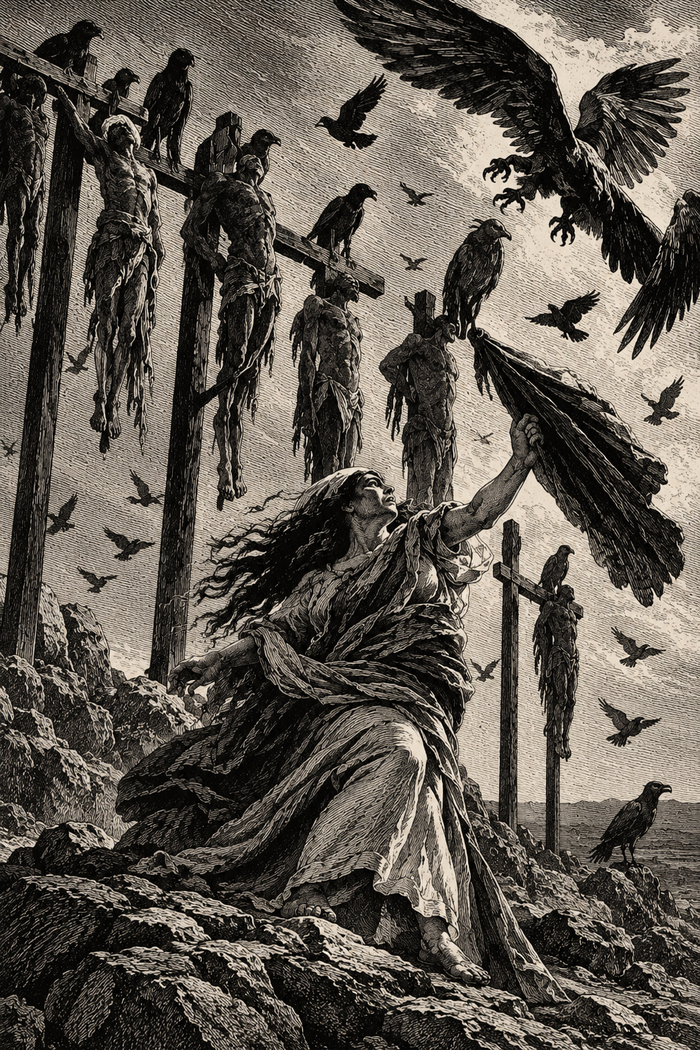
The Cornell Seven have captured our collective attention, but Scripture gives us another seven. Seven men handed over by a king, killed, and left exposed before the Lord. And standing beneath those seven bodies is a woman named Rizpah. I believe her response gives us the very wisdom for action we need.
Our introduction to Rizpah takes place in 2 Samuel 21. Her story is actually embedded within the ongoing narrative of David’s reign as King of Israel. Even in her story, Rizpah is a supporting actress to David’s lead role. Let’s follow the text and see what our ancient heroine has to say about present-day realities.
The context underlying the story is famine and war. Israel has been suffering from “famine for three successive years” (2 Sam 21:1). Such a famine is confusing to King David, the man after God’s own heart, and so he “sought the face of the Lord” whereupon he is told that the famine is the direct result of Saul. More specifically, the famine is unrelenting because of “Saul and his blood-stained house; it is because he put the Gibeonites to death,” (2 Sam. 21:1).
That’s an important piece of information, not simply because God identifies the cause but because the catalyst is David’s predecessor in leadership. We are only three verses into the story and we have our first instance of a leadership failure. The writer of 2 Samuel expounds on Saul’s sin in verses 2-3 through David’s inquiry with the Gibeonites.
The Israelites had pledged protection for the non-Israelite Gibeonites, but Saul went back on that pledge and killed them. He violated Israel’s oath. The Hebrew word used here for sworn—as in “Israel…had sworn…”—is šābaʿ. This is more than a promise; it is an oath or pledge made “by calling upon a deity to witness it.” Saul had violated this God-witnessed oath. But Saul is dead and cannot be called upon to answer for this covenant-breaking.
In response to the new information, David asks the Gibeonites, “What shall I do for you? How shall I make atonement so that you will bless the Lord’s inheritance?” This seems like a fair solution to an ongoing problem. The Gibeonites are the aggrieved party and David wants to know how he can satisfy their desire for justice, even with the knowledge that their offender (Saul) can no longer be punished by mortals.
The Gibeonites are aware that they have no right to financial compensation (that which we would call damages in our legal system) or the death of any Israelites (no invocation of an eye for an eye here). But David presses the issue further by asking “What do you want me to do for you?” and it is here that we finally see the landscape of retributive justice beginning to take shape, and David is not innocent in how it all plays out.
The Gibeonites want seven sons of Saul to be handed over to them, put to death, and their bodies displayed before the Lord in order to satisfy their need. Not just any Israelites, they have already identified the general population as being beyond their reach, but descendants of Saul their enemy. Members of the royal household, relatives of the former-and-now-deceased king.
This is no small request, but David grants it. Why?
It can be easily postulated that David saw this as a win-win for his own household. By making peace with the Gibeonites he would have one less enemy. By satisfying their anger upon the Lord’s instruction, he might end the famine. But there is another, more cynical layer: handing over Saul’s descendants for execution clears David’s claim to the throne even further. The text does not say this explicitly, but I think the implication is warranted, even if from a midrashic perspective. We have reason to read the text through a lens of political suspicion, particularly because we are told that David is the one who selected the seven men for death.
David spares Mephibosheth because of his oath to the boy’s father, Jonathan. There is a nice juxtaposition in the text with David keeping his oath but Saul breaking his. If we stop at the point of this differing leadership style we would be willing to see David as the hero in the story, but by digging deeper we are given another leadership problem. David picks two of Saul’s sons, heirs to Saul’s throne, born to him by his concubine, Rizpah. The other five are Saul’s direct grandsons through his daughter, Merab. Essentially, David is wiping out two generations of Saul’s family.
Is it what the Gibeonites asked for? Yes.
Does it serve David’s political career at the same time? Absolutely.
The boys are killed together during “the first days of the harvest” with their bodies “exposed on a hill before the LORD” (2 Sam. 21:9). The demands of the Gibeonites have been met; blood has been shed to atone for previous deaths.
Surely, the end of the famine is right around the corner with the heavens preparing to open up for the harvest, right?
This is only half of the story. The second half, the more important part, focuses on Rizpah. This concubine, lesser wife of Saul, is only the mother of two of the boys and has no real standing in the House of David. In fact, Saul’s first cousin Abner is accused by Saul’s son Ish-bosheth of having “gone into [his] father’s concubine.” Rizpah has no agency in that story, she is given no voice in the text, and she has no position in the royal household, and yet she acts on behalf of all seven.
Rizpah is unable to protect her family from death, unable to evade the long arm of the monarchy, but she is able to protect their fallen bodies. And she does not guard only her two sons. She keeps vigil over all seven—Rizpah’s seven—day and night.
For months and months she keeps vigil over the bodies, protecting them from the elements and from scavenging birds who would eat their flesh.
You have to imagine the parallels between Rizpah and Mary. Mothers who witnessed the murders of their sons. Mothers who could do nothing, sons who did nothing. Sons who were killed on a tree.
Who is Rizpah protesting? She’s protesting David. She is demanding justice for these fallen men. She understands that if the bodies are carried away by carrion, there can be no proper burial and thus they are as cursed after death as they were in death.
And notice that the famine has not stopped. It is harvest and there is no food. When news of her vigil reached David, Rizpah’s response to injustice spurred him to action. I think we can even use the word “conviction” here without overstepping. David has the bones of Saul and Jonathan gathered and buried with the bodies of those who had fallen, not by his hand but by his selection.
It is only then that the famine ends. That justice is done. That the covenant was kept.
Church, we need our own Rizpah response in this moment in history.
We live in an age of contempt and rage where we are better at cancelling one another or dehumanizing the other than we are at finding common ground through Christ our King. We inhabit a space awash in documented cases of child sexual abuse, sexual misconduct, pornography, alcohol abuse, and scandal among clergy. And sadly, Christians are more than willing to add their cries to the outcry of outrage in instances like Cornell, but we remain steadfastly silent when it hits closer to home: scandals in our parishes, politically infused Christian nationalism in our pews, failures of leadership in otherwise healthy and growing churches. No matter the situation, we are not leading by example. We are not, in the words of the late liturgical theologian, Fr. Aidan Kavanagh, “doing the world the way the world was meant to be done.”
We need a Rizpah response and we need it now.
From Rizpah we are given valuable wisdom as to what faithful action looks like in the face of injustice and betrayal.
Rizpah is unrelenting and persistent in her protest before the King of Israel. At this point, David is the most powerful person in Israel’s history and his primary enemy (Saul) is already dead. She risks her very life to make sure her protest reaches the King; she counts the cost and she is willing to pay it.
Rizpah bears witness to the atrocities exacted on all the sons of Saul, not just her own. Rizpah represents her sons and the sons of another woman in the royal household, one who had more standing than she did. Rizpah could have saved only her sons, but her grief expands rather than contracts her moral universe.
Rizpah holds the institution accountable. Rizpah understands that oaths have been broken and families have been betrayed, both hers and the Gibeonites. What has happened to Saul’s sons is the fault of both Saul and David, i.e. the monarchy, and Rizpah will not be stopped until the King does right by everyone. It is only when true justice (read: God’s justice) is done and every last murdered body is accounted for that the famine ends.
The story unfolding in Ithaca is shocking. It is deserving of our outrage and our protest. Young men failed. School leadership failed. Everyone failed Jane Doe. But we cannot allow ourselves to only raise our voice in protest over what happens outside the walls of our churches when we sit silently – remember, that which you permit, you promote – with abuse, betrayal, and failures inside our walls.
Our Rizpah response of lamenting, crying, tearing sackcloth and ashes, protecting dead bodies, guarding the innocent and vulnerable, and holding leaders and institutions accountable is exactly what our Good Shepherd does for us. As we see the Lord walking through Galilee and Judea in the Gospels, we are given the picture of a Messiah who is moved to compassion for the crowd, who wept over Lazarus, who had the little children come unto him, who laid down his life for his friends, who broke bread with sinners and tax collectors, who touched lepers and healed bleeding women, who turned over the tables, who brought the marginalized into the center, and who offered forgiveness on the cross.
Christ identifies himself with violated bodies. “As you did it to one of the least of these...” He touches bodies others regard as unclean. He refuses to pass by suffering. He himself becomes the exposed body, killed by an alliance of religious and political power, hanging upon a tree. And then God refuses to allow that body to remain under the power of death. Christ is our true Rizpah and as his disciples, as his hands and feet, as his body broken for the life of the world, we must respond like Rizpah, as well.
Lord, have mercy.
Christ, have mercy.
Lord, have mercy.