
Sermon + Commentary: Idols, Invitations, and the Immortal
A Note on Sermon Commentaries
A sermon is an act of proclamation, not an academic lecture or an exhaustive treatment of a biblical text. Every sermon involves choices: what to emphasize, what to leave unsaid, which theological threads to follow, and how to move from the written Word to the Word made flesh.
These commentaries offer a glimpse into that work. They are not attempts to defend or explain away a sermon, but invitations into my workshop to explore the exegesis, theology, imagination, and pastoral judgments that shape what is eventually proclaimed from the pulpit.
Sermon
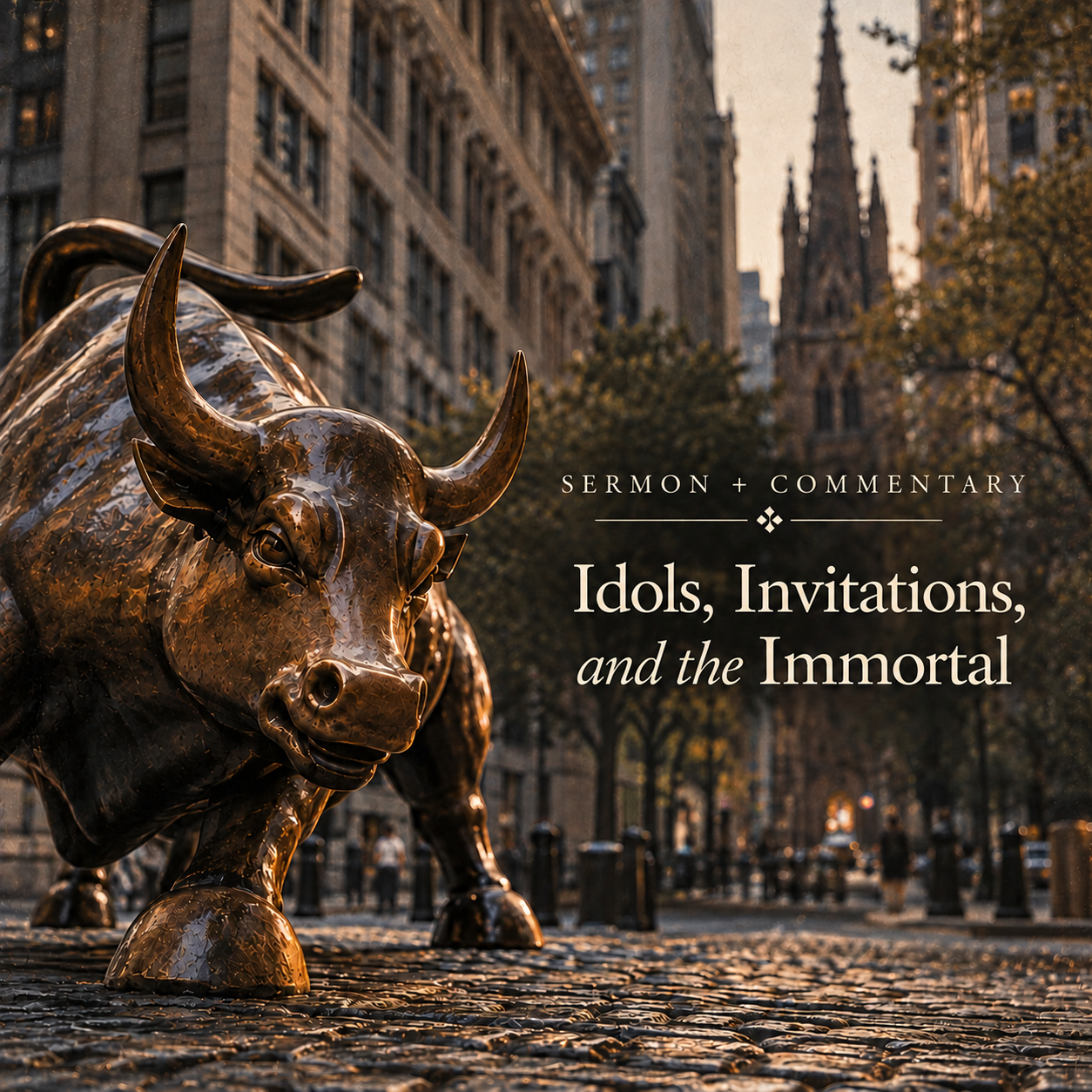
On December 15, 1989, a flat-bed truck pulled onto Broad Street in Manhattan before sunrise. The driver and his companions unloaded a gift under the Christmas Tree in front of the New York Stock Exchange. Among them was Arturo di Modica, an Italian sculptor who had moved to America in the 70’s. Di Modica was expressing his gratitude for his reception in this country, especially after the 1987 Stock Market crash.
Di Modica spent $360,000 creating the gift: a sculpture: 11-feet tall, weighing 7,100 pounds. It had been cast in a foundry in Brooklyn.
Its name? Charging Bull.
Just two years after the market’s collapse, di Modica tried to capture America’s hope for a bull market, a rising tide to lift all ships.
Intended as a gift symbolizing the “power of the American people…prosperity and strength,” the Charging Bull was not well-received by Wall Street. In fact, the authorities were called and the bull was impounded that very day. Despite its short cameo, the bull’s removal sparked public outcry. Ultimately, Parks and Recreation relocated the sculpture two blocks from its original site.
During our trip to New York in June 2022, Rebecca and I walked up Broadway to Trinity (Episcopal Church) Wall Street. To be clear, we weren’t going to see Trinity as much as we were going to see Alexander Hamilton’s gravesite. (Werk!)
Hundreds of tourists and onlookers were waiting to have their pictures taken with the bull.
There’s an urban legend that if you rub – umm, how should I put this? – near the rear of the bull, you’ll have a positive financial forecast.
It was a spectacle to behold;
Pilgrims paid homage;
A visible icon symbolizing an invisible quality;
An invitation to worship.
In Scripture, there is only one word for this: idolatry.
This is our scene in Exodus 32.
Moses and the Israelites made it safely to Mt. Sinai where they were consecrated or set apart as YHWH’s redeemed people. The law was first given verbally by the voice of YHWH and known as the “ten words” before ever being called the two tablets. The people were so afraid of YHWH’s presence that they demanded a middleman, imploring Moses to speak directly to him on their behalf.
After the law was given, Moses went up to chat with God.
Apparently, he was gone longer than was socially acceptable and the people began to panic with anxious distrust.
You know that feeling when someone is slightly late but you have them in a ditch somewhere. They couldn’t track his movements. He forgot to turn “Find My Phone” on, his Apple tags were back in his tent.
So the people do what they do best: they grumble about Moses and God. Again. The Israelites are scared.
Fear may be a good motivator, but fear is never a trustworthy companion. Gripped by terror, they demand that Aaron make gods who will go before them. Moses, their visible leader, had obviously abandoned them. They want something to follow, something they can touch and see, and if we’re being honest, something who will do everything they want.
Paradoxically, they both write Moses off as an absentee ne’er-do-well and give him credit for the Exodus, rather than God. Ignoring God’s powerful provision, the people will soon reject his promise and presence.
Israel turns to Aaron, the presumptive #2, and present their complaints to him. Curiously, they refer to “gods” in the plural rather than the singular. Israel had recently heard the voice of the one God saying they shall have no other gods. This event was etched in their memory because they were afraid of God’s presence, of his utter holiness, and yet they quickly requested different gods.
We know they aren’t asking for YHWH because he has been going before them for the last two months! Pillar of cloud by day and fire by night, consuming presence, water from the rock, bread from heaven. Their God has been going before them, but they want something different. Something accessible, portable, and manipulatable.
Israel wanted images of their new gods. Their God, the God of Abraham, Isaac, Jacob, and Moses was invisible. The living God could be seen through fire and cloud, plague, passover and parting the sea, but the people wanted something they could look at. In their short-sighted haste, they trade the invisible for the visible, the one true God for a false idol, the omnipotent for the impotent.
The true irony here is that Aaron is not the leader-in-waiting! There is no succession plan with Aaron’s name at the top of the list. In fact, Moses had just appointed Aaron, Hur, and 70 elders to share in the ministry of leadership. Aaron should have told this grumbling group “no” and consulted with his fellow leaders, but in an apparent moment mixed with weakness, insecurity, and ambition, Aaron grasps the mantle of leadership without possessing any authority. He capitulates and accommodates the peoples’ sinful, god-forsaking, Moses-neglecting requests without even a feeble protest.
Aaron’s best thinking is to have the people turn in their gold. This is the same gold their Egyptian enslavers gave them as they were leaving town. This is the very God-given gift from plundering Egypt.
God’s metal is melted into a molten-idol.
They begin to worship the gift rather than the Giver.
And it's not just any idol. He turns it into a golden bull. The word actually means “a young bull in his first strength” and can indicate a bull of up to three years old. We’ve already talked about a bronze bull this morning as a symbol of financial strength and prosperity, but this takes the cake.
Do you remember the false god, Baal?
The Canaanites depicted Baal as a bull. Baal worship was among the worst idolatry in the Old Testament. Remember, Exodus is written by scribes while Israel is in exile because…wait for it…she had rejected her God and worshiped false gods like Baal. While there is no proof that Israel wanted to worship Baal at this moment, the irony is devastating.
Aaron fashions a golden bull and then proclaims, “There are your gods, O Israel, who brought you up out of the land of Egypt.” Aaron is using the plural for god, again, but he is doing so with reference to what YHWH has done for his people. Perhaps in an attempt to redeem the situation, Aaron only makes it worse by taking the LORD’s name in vain and applying it to an inanimate object.
Israel breaks the first three commandments in rapid succession. This is what happens when we give into our sinful desires and bad behaviors. “Their use of the gold contradicted the redeeming work of the Lord, as represented by the tabernacle; the making of the image contradicted his word; and calling it by his name contradicted his revealed nature. The people had exchanged the invisible God who had led them by his spoken word for a visible ‘thing’ which could not speak.” Oh the irony.
We need to dig deep into our own hearts.
We consistently erect idols in our hearts, in our churches, in our lives.
We bow down and worship false gods, graven images, inanimate idols.
We trade the immortal, invisible for the visible and visually appealing.
And we need to confess.
We need to repent.
We need to tear down the altars in our hearts.
In Two Kings 23, you will find the description of how King Josiah restored right worship in Judah by destroying the altars, idols, and high places. May the Spirit enable us to do the same!
Aaron doesn’t confess their sins before God, instead he builds an altar and sets the next day as a festival to the LORD.
During this festival they eat, drink, and then “rise up and play,” a phrase that may function as a euphemism for a ritualistic orgy.
Commandments are broken;
God’s name is profaned;
Humanity is degraded;
Hedonism is celebrated.
Covenant is shattered.
At least on one side. Israel breaks her covenantal relationship with YHWH in the name of religious intoxication!
As the revelry unfolds, YHWH tells Moses to get back down there. Notice that God does not refer to the people as his people but as Moses’. God then refers to the people as “stiff-necked.”
This is a farming term.
Stiff-necked-edness refers to an ox or horse that won’t respond to the rope when tugged. Imagine riding your horse and it won’t respond to your pull, even with the bit and bridle firmly in place. To be stiff-necked is to be extremely stubborn.
And this is where our passage gets tricky.
This is one of the “tough passages” in scripture because it appears that God disowns his people after they have disappointed him. While all Scripture is inspired, there are still human limitations at play. Too often we discover what is known as anthropopathism which is a really fancy word for applying human emotions to God. The writers of Exodus are using an analogy to explain the inexplicable.
Did Moses actually change God’s mind? No, of course not. God is neither malleable nor changeable.
Did Moses remind God of the covenant and God chose to go in a different direction? Yes!
God is still keeping his covenant though he had every right to let his anger burn hot. He is still steadfast, faithful, and will fulfill the promises he made to Abraham.
We miss our Charlton Heston moment by only a few verses. Moses comes down the mountain with the two tablets of the law in hand, he sees the drunken, degrading activity unfolding and he shatters the tablets on the ground in his righteous anger and then he melts the golden bull, destroying its idolatrous presence.
Israel had been invited further up, further in with her redeeming God and yet she settled for a golden, graven, god-substitute, utterly incapable of leading her and wholly ineffective, immobile, and impotent.
But Moses accepts the invitation and holds on for all of Israel.
Aaron failed, the people failed, but Moses did not.
Our other tough passage, Matthew 22, also has something to say about invitations and the immortal.
Jesus is still teaching in the temple precinct and it is still the day after the triumphal entry. This parable is very much in keeping with the two that have come before – the wicked tenants and the two sons.
It feels like a story that can’t make up its mind about its plot twists or overall meaning. There is judgment, death, weeping and gnashing of teeth, and punishment for wearing the wrong garment. I wouldn’t blame you for thinking What’s going on here?
The key to this parable is that Matthew’s biography of Jesus was written after the destruction of the Temple in 70AD. The story functions as an analogy regarding Israel, but it includes elements and references to the city of Jerusalem after it was sacked by the Romans.
A king throws a wedding feast for his son. All of the right people have been invited. Invitations have gone out with copper plate engraving, formal titles, formal names, and formal attire. This would be the event of the season! A-list invites only.
Just think: 170 million people watched William and Catherine get married, 400 million watched Charles’ coronation, and 750 million watched Charles and Diana get married. Royal to-dos are big events!
But the invited guests have not responded positively.
On the seating chart, they are listed as “not attending.”
No matter how persuasive the king is, no matter how many messengers he sends to invite them anew, the people reject and reject. They go about their business: farming, raising families, picking their noses, watching paint dry. They beat, mistreat, abuse, and refuse all of the messengers.
Side note: these messengers are the prophets, those whom God called to give warning and hope. Those whom Israel beat, stoned, sawed in two, and killed. Those of whom Jesus is the greatest and will meet a similar fate.
The piece about burning the city is a reference to what happened to Jerusalem in 70AD as a result of the religious leaders’ long history of rejecting God’s invitation.
But a new group is invited.
Some good, some bad, but all come.
Rejecting the gospel does not make it false, inaccurate, or unimportant. Facts do not require our approval. Rejecting the gospel simply puts you on the outside looking in but the party will still go on because the kingdom is always, still in motion.
It looks like this is the end of the story, only it isn’t. Some who were invited, who accepted the invitation, and who showed up will not stay for the proceedings.
The king notices someone not wearing the right clothing and so he casts him out.
What is the garment here and why was it wrong?
It could be faith.
It could be “works.”
Or, it could even be both.
Either way, this man was not wearing the proper garment.
In the ancient near east, it was common for royal and wealthy families to provide suitable wedding garments to their guests as a show of hospitality and generosity. Someone’s “Sunday best” may not be as fancy as what you find on the cover of Vogue. And what happens if you are invited to such a party and you don’t have the funds or the friends to get a suit? Well, that’s why they provided racks outside of the venue.
It would take actual work, an intentional decision, to show up at a wedding in the wrong garment. You had to make a willful decision to accept the invitation but reject the wearable grace.
Ultimately, this is yet another parable about discipleship. What does it mean to belong to the community of faith, to the community of disciples?
Sadly, too many people idolize the invitation. The invitation becomes the thing rather than the One who issued the invitation.
“This theme of distinguishing between mere claims to membership and the reality of discipleship recurs often in this Gospel; Belonging to the Church as a mere social fact will not be enough…for discipleship requires our real commitment.” (McGowan)
Discipleship isn’t about belonging to the right (country) club, having the right (church) membership, or earning with the right status card.
It’s about participation in the community of the forgiven-and-redeemed.
It’s about joining the Kingdom where the King is already at work.
It’s about casting down idols and bowing down before the King of kings and Lord of lords.
It’s about ascribing to the Lord the honor due his name.
Because he has redeemed us, he has forgiven us, he has saved us, he has invited us, and he will sustain us.
Beloved, we don’t need a charging bull.
We don’t need a golden calf.
We have the paschal lamb.
And he is seated on the throne in glory, power, and splendor.
And he is all that we need. Amen.
Commentary
This sermon was originally written and preached in 2023 at St. David’s by the Sea where I was serving as rector, but its origin story moves us back to 2022. Rebecca and I had gone on a vacation to New York that year, just the two of us. It was the first time we had been away together for more than an overnight since we had kids. I had never been to New York before and it was her favorite city. We spent weeks planning the whole thing: hotel location, meals, Broadway, museums, everything.
We found ourselves in the Financial District one afternoon after spending the morning in SoHo. Part of our trip included seeing Hamilton on Broadway, so we were interested in seeing Hamilton’s gravesite at Trinity Wall Street. Did I shamelessly tell the docents at the church – after a lengthy security process with more armed guards than I could count – that I was an Episcopal priest and please could we see the sacristy? Yes, yes I did.
Anyway, as we were walking toward Trinity, we saw a massive crowd of people with their cameras out, all queuing up to take a picture with something. As we drew closer, we could see that it was the Charging Bull. There was an eerie quality to the whole thing. The people taking pictures and rubbing the rear side of the bull were clearly tourists – you could spot actual New Yorkers scoffing silently at them – but there was a sense of reverence and otherworldly excitement about them. It was as if they were accessing something beyond the bronze. Anyway, I knew at that moment that I was seeing an idol with its idolatrous people and that it would make for the perfect sermon opening whenever Exodus 32 popped up in the lectionary.
Little did I know that I would have to wait 16 months and that the story behind the bull was just as intriguing. When Proper 23A came around that next year, I began my research. The story of the 1987 stock market crash (just a year after I was born) and the gratitude of an Italian immigrant sculptor for the support he had received was brand new to me. I had no idea that the current location for the statue was not the original or that it had been poorly received in Wall Street. Spending $360,000 to say “thank you,” felt excessive but then again, it was Wall Street.
The reason this whole thing stood out to me is simple: we all understand the lure and allure of wealth building, moneymaxxing, and mammon. We can acknowledge that we are working to be above it or beyond it, but we cannot do away with it entirely because it is the way the secular world works.
You know what the Golden Rule is, right?
No, no that one.
This one: whoever has the gold makes the rules.
Feels pretty apropos in the year of our Lord, 2026, as personal wealth is at an all-time high. As of October 2026, Forbes lists the top 10 wealthiest Americans as having a collective net worth of $3.12 trillion. With a t not a b or an m. That figure from just ten individuals is greater than the GDP of 185 countries in the world.
We understand the symbolism of the Charging Bull because we are living in its waking reality. It is an icon – in the truest sense – of so many hopes, dreams, and longings in the world. And if we can’t see it for what it actually is – an idol – then we will miss Exodus 32 and Matthew 22 entirely.
There are multiple ways you can get to the Charging Bull, I opted for di Modica, but I think the pairing of a bronze bull and a golden calf is too delicious to ignore.
With the image of financial prowess (a bull in its first strength) firmly in mind, it was time to move into the Exodus passage. Let’s be honest: both the OT and Gospel readings for Proper 23A have difficult qualities about them. In Exodus, it is the issue of God wanting to allow his anger to burn hot against Israel. In Matthew, it is the chucking out of an invited guest because he wasn’t wearing the right attire. Those both require explanation, but neither were the primary point of the thread I was following.
In Exodus, we are seemingly stuck in the middle of Israel’s grumbling cycle. Every week it feels as though Israel has something new to complain about. And every week I find myself reminding folks in the pews that we must not turn this into an us versus them situation where we are somehow morally superior and emotionally more virtuous than the Israelites. The reality is that we are the Israelites. Not that we have replaced them but that we are constantly grumbling, complaining, and ignoring the words of the Lord.
The real work isn’t to be found in pointing our fingers at those people way back then but taking an honest look in the mirror and doing the heart-and-soul work to figure out where we are in the bondage of slavery, grumbling, and idolatry.
The cause of Israel’s grumbling this time, as you know, is that Moses has been gone too long. There is probably a lesson here about what it looks like when parishioners decide that they get to dictate where the leader should be, when, and for how long…but that’s another story for another time.
Moses is convening with God atop Mt. Sinai and the people of God begin to feel listless, rudderless, and leaderless. They don’t know what to do and instead of resting and worshipping they grow “restless, irritable, and discontent” as we would say in AA. The decision to go to Aaron is interesting. Clearly they believe in a succession plan for leadership just as they would have seen in Egypt. Aaron is Moses’ brother, he is the “next in line,” and therefore obviously qualified to lead in his absence.
Every time I read this story, I am desperate for Aaron to resist the temptation to take power. I want to see some Gandalfian wisdom wherein Aaron knows he is not the one to lead, only to assist, and to see him close the ring of power back in their palms. But he doesn’t. We don’t know if his acquiescence here is out of compassion, ambition, or placation, but what we do know is that it doesn’t go well.
This passage feels like the precursor to what we see in 1 Samuel when Israel has the audacity to say, we want a king like the other nations. Here it gives, we want a leader to go out before us like everyone else has. By the time we get to 1 Samuel, we should not be surprised by the demand, however devastating it may be, because we have seen this heart attitude growing in the dark and dank places of our own hearts.
The request for a visible figurehead comes at a price: you can see it but it can’t act. It also comes with a built in irony: YHWH has been present, visible, and active from the beginning. For me, this means that Israel wanted a leader or figure they could manipulate, bend, and control. One from whom they could make demands and expect results. One would remain silent but ever faithful to do things the exact way they wanted them done.
This is not unique. We see it in churches and denominations all the time. People say they want courageous, visionary leadership but what they actually want is leadership that looks like them, talks like them, votes like them, is biased like them, and that gives them what they want, when they want it, and how they want it.
Welcome to the jungle of the sinsick soul.
Israel is lonely, afraid, and despondent. She acts the only way she knows how and the heir (not)apparent does not see through this.
This story takes one depressing, harrowing turn after another. Our hearts should collectively break as Aaron tells the people what to do. Take the gold, the precious metal which YHWH gave to you as you left Egypt and I will make you a new god. Aaron is using the very gifts from God to break three of the ten commandments and lead the people away from God.
This is idolatry at its most basic: mistaking the gift for the Giver; worshipping the thing rather than the Creator.
Idols make extreme claims over your attention, affection, and admiration without giving you anything in return. They are a black hole of all that should be given to God and their demands are so subtle, so crafty, so seductive that we miss it until we are in over our heads.
No one sets out to make an idol.
At least no one that I know.
Instead, we see something good or pleasant or efficient and we start giving ourselves over to it – all in the name of goodness – one little piece at a time.
It’s like the frog being boiled in water with the temperature slowly, gently increasing.
And Aaron not only allows this, he authorizes it.
And the people obey.
They give their God-provided metal and it becomes a molten idol.
I really struggled with how to describe the use of the phrase “rise up and play.” I do believe that it is a euphemism for a ritualistic orgy and that the meaning fits the context of idol worship in the ANE. I also am aware that spending too long on that point with any amount of detail will both a) distract the listener and b) become inappropriate for younger ears. Not inappropriate and therefore untrue, but unnecessarily confusing for individuals with their innocence still intact. I still used the phrase, but I did it only once.
And all of that led us to the actual challenging portion of the passage: God’s response. The writers of Exodus tell us that God’s anger is burning white-hot against his chosen people. God refers to them with Moses as your people.
When one of the boys (or all of them) acts in an inappropriate way, Rebecca and I will look at each other and say, “They’re your children.” It’s funny but with a dash of seriousness mixed in. God has every right to be mad. He is Israel's covenantal partner, the promise-maker and promise-keeper, and they have betrayed him. They have broken three of the ten words within weeks of being consecrated as his people.
I do not believe Moses actually changed God’s mind. I believe Moses intercedes on Israel’s behalf and reminds God of the covenant he has made, but God needs no reminding. He has not forgotten the covenant or his people, and his love has always been bent toward their deliverance, flourishing, and salvation.
If Moses changes God’s mind then God is able to be controlled or manipulated. I’m reminded of Beaver’s words here: course he isn’t safe, he’s a lion. But he’s good. God is good and his hesed steadfast. That’s how I read this passage and that’s what I preached.
But one hard lection deserves another.
Matthew 22 is, in some ways, more difficult than Exodus because we see judgment and weeping and gnashing of teeth over the wrong garment. Why does Jesus’ parable involve death, destruction, and someone being discharged from the party? Simply put: the fall of Jerusalem.
Matthew’s biography of Jesus is written after the fall of Jerusalem and the destruction of the Temple in 70AD. This parable cannot be read apart from Israel’s past (the prophets) and what will happen in the future/present (Jerusalem). Jesus has known that the city on the Hill would face trials and tribulations; we see this theme throughout the gospels. The point here, however, isn’t the destruction of the city but the wearing of proper wedding garments.
As with other Matthean parables in this Parable Girl Summer, Jesus has been depicting the kingdom of God through images where messengers are mistreated. The wicked tenants are a great example of this. In this parable, the king’s heralds are beaten and mistreated, abused and killed. I wanted to go further with this to explain the prophets. These servants represent Israel’s prophets: as tradition has it, Jeremiah was beaten and it is believed that he was stoned, Isaiah was sawn in two, Ezekiel was killed, and John the Baptizer was beheaded.
Prophets bearing the warning of exile and the good news of salvation were killed by Israel. Jesus would soon meet the same fate. We cannot ignore this or gloss over it. We have to sit with the murderous temptation that resides in our hearts, we have to acknowledge that we are just as likely to shout “crucify him!” as we are “hosanna,” that we would willingly “call out among the scoffers” as our sin held him to the cross.
The garments are an interesting and oft-forgotten piece of ancient history. With people finally attending the royal to-do, both the right sort and the wrong sort, they may not have all been able to get in touch with Rent the Runway or Jos.A.Bank for their attire needs. It was customary, especially in wealthier settings, for the host family to provide wedding garments as an act of hospitality and generosity (and to make sure pictures looked good!). To attend the wedding in the wrong attire would take effort.
We were watching The Real Housewives of Salt Lake City last night and the conversation in the sprinter van turned to invitations to the Oscars. As the conversation unfolded, it became clear that to most of the women in the van such an invitation was a status symbol worthy of jealousy. The invite to the Oscars or a ticket to the World Cup final was something to be idolized. I think there is an element of that in this parable. The people who are attending the wedding were not the most worthy or deserving, they weren’t on the original guest list, but how easy is it to turn the invite into an idol?
When you superimpose this onto our twenty-first century context, we see social clubs, friend circles, memberships, and status as becoming idol worthy. It may be the country club or the political party or the AmericanExpress black card or any other symbol of belonging and we make it become the thing toward which our whole lives are oriented.
The point wasn’t coming to the wedding but dressing in the robes of discipleship as a citizen of the Kingdom. Do you see the difference? These were never stories just about graven idols and engraved invitations. They were always about following the true, living, Almighty King; about directing our admiration, attention, and affection toward the One who is worthy of all praise; about reordering and re-aligning our lives according to his will and way rather than our whims and wiles.