
This sermon was originally preached at Church of the Redeemer in Greensboro, GA on Sunday, October 18, 2026. The lectionary texts for the day were from Proper 24A (Track 2) and were Isaiah 45:1-7; Psalm 99; 1 Thessalonians 1:1-10; Matthew 22:15-22.
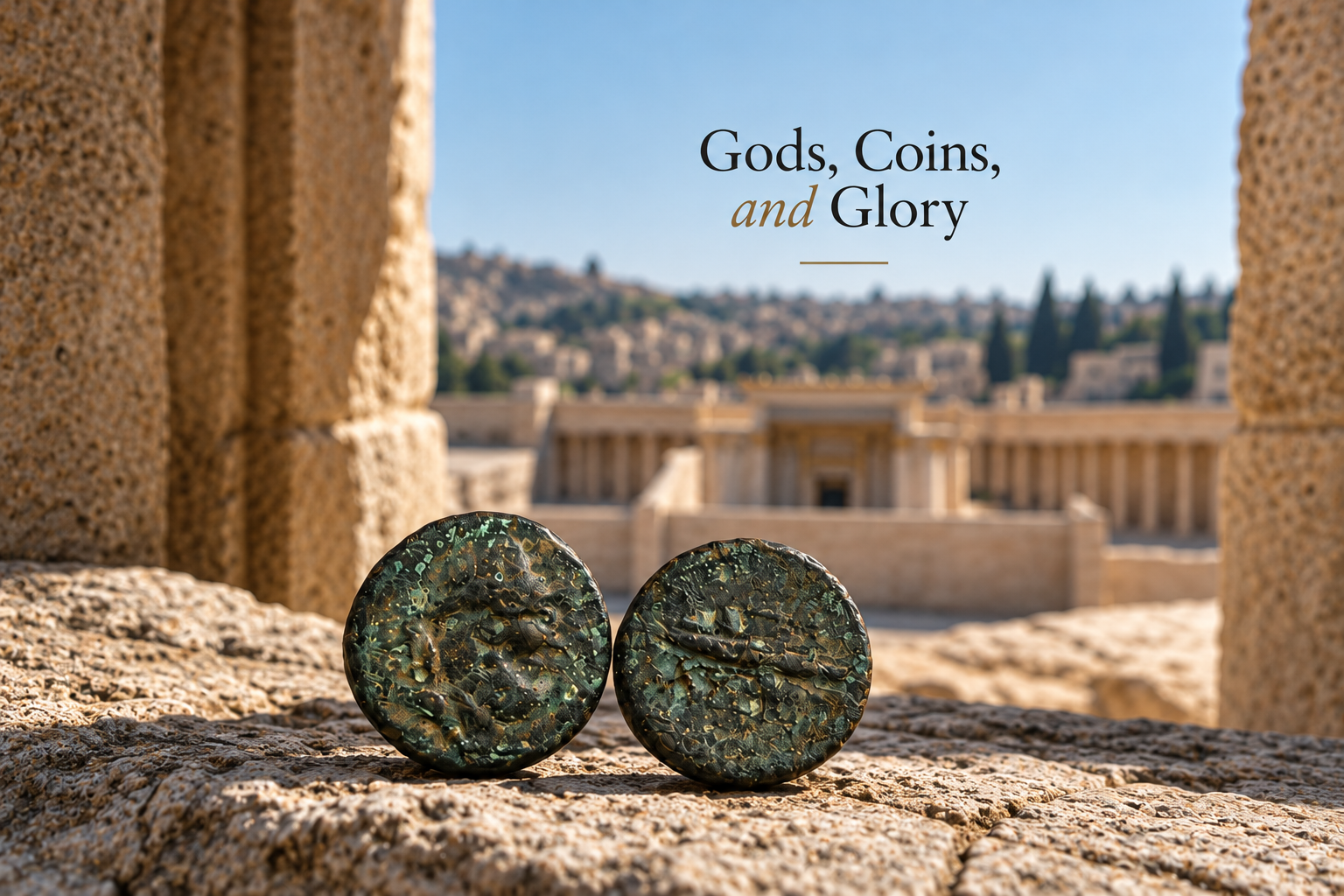
Gods, Coins, and Glory
A coin is never just a piece of money. Every coin tells a story of antiquity, authority, and identity. The goal is to find items of increasing rarity.
Growing up, my childhood best friend, Christo Landry, would give a 50-cent piece with JFK emblazoned on one side as a party favor. That was my introduction into coin collecting or numismatics.
But I am no numismatist.
Our oldest son, Jet, however, is.
I don’t know where his love for coinage came from, but several years ago he began collecting. His first coins came from the loving parishioners at our former parish in Cocoa Beach, Florida. Many of them had traveled the world – either for leisure, business, or as GIs – bringing home a veritable treasure trove of exotic coins.
One by one, Jet was presented with little bags containing pieces from Norway, Germany, Iceland, and beyond. He then used a currency app to see how much a 1939 Norwegian krone was actually worth.
The answer: very little.
For his birthday one year, Case had the brilliantly inspired idea to present Jet with an ancient coin. After poring through websites and online catalogues, Case settled on a bronze coin from the ancient Mediterranean world. And it is a special one:
On one side, the head of Zeus, king of the Greek gods, the god of thunder and lightning.
On the other side, a thunderbolt bursting into wings.
A little bit of research this week helped us determine that this bronze coin dates to approximately 36–25 BC and was minted at Cremna in Pisidia, in modern southwestern Turkey, under the king of Galatia.
The value of money is never simply the sum total of the material from which it is made. It depends on the authority and trust behind it, and on the value we agree to assign it. And we do love to put important people on our coins and bills, individuals who helped build a country, who led in battle, and who governed well.
And in the Mediterranean world, coins often bore the likeness of one of the gods or the reigning ruler. The Cremna coin in Jet’s collection is making a theological statement as much as it is a numismatic claim: Zeus is god, Zeus is king, to Zeus be the glory.
Coins and currency are part of our everyday life.
We may have too much, too little, or just enough, but cash, coin, and credit are king in our culture.
And that raises an important question: what do coins and currency tell us about gods and glory?
Matthew’s biography of Jesus is our obvious starting point and we pick up the story in Matthew 22:15.
Jesus is still teaching in the Temple. While this is the same day as the parables from the last several weeks, in today’s scene the Pharisees are now on the offensive.
The parables from our Parable Girl Summer have inflamed in the Pharisees a burning desire to entrap him, to bait him, to tempt him into saying something he shouldn’t. They want Jesus “on the record” admitting to blasphemy which will allow them to silence him permanently.
This is not the first time someone has attempted to entrap Jesus.
In Luke 4:1-13, you’ll find the story of Jesus being tempted by Satan. After his baptism, Jesus is led into the wilderness by the Holy Spirit to battle the devil. The accursed, accusing adversary waits until Jesus is famished before striking. Jesus responds to each temptation with Scripture, thwarting Satan at each turn.
Luke then writes: “When the devil had finished every test, he departed from him until an opportune time.”
In Matthew 22, the forces of evil and darkness are relentlessly working to end Jesus. Satan has found his opportune time to strike.
We know that something nefarious is afoot when we discover the unlikely union between the Pharisees and the Herodians. The Herodians are Roman devotees whereas the Pharisees were devoted to righteous living and rightly interpreting the law. They would love for Rome to be cast out of Jerusalem, but not by the power or might of the blaspheming Jesus.
In a “the enemy of my enemy is my friend” move, the Pharisees and Herodians join forces. The group in front of Jesus is a mix of Herodians and the Pharisees’ disciples.
They attempt to flatter Jesus with their opening comments. They don’t know that their mock praise will never seduce the One worthy of all praise. Then they put their trap in front of him: Is it lawful to pay taxes to the Emperor?
This is a supercharged, very loaded question, especially coming from the legalistic Pharisees.
In 6AD, Judas of Galilee led an attempted revolution against Rome. Judas’ main issue was the imposition of Roman taxes on Jews living in Israel. His solution was a military revolution.
A revolution based on taxation without representation, interesting.
Judas and the revolutionaries who would come after him were branded as ‘Zealots’ for their beliefs. The Zealots were supporters of militant nationalism and they had a popular following.
So, if Jesus says that he is against paying taxes, then he is casting his lot with the militant Zealots and guilty of treason against Rome. However, if he says that he supports taxes then he would be seen as pro-Rome and lose a large portion of his following.
Jesus is being forced to come out as either pro-Empire or anti-Empire. Each answer would have serious ramifications. For the plotting Pharisees, Jesus’ position is weakened no matter what.
The tax that they are asking about is the poll tax paid directly to Rome. And the law which they are inquiring about when they say is it lawful is not the law of Rome but the law of God.
Their core question is this: is it permissible for the people of God to express allegiance to a (pagan) emperor?
Jesus knew that their question was designed to harm and hurt.
He knew the malice in their hearts.
He knows the malice in our hearts.
He knows our feelings of anger, discord, or dishonesty; or when we are restless, irritable, and discontented; he knows when we are maligning people in our hearts or in public, all “in the name of God.” Thankfully, our God abounds in mercy.
Jesus calls them hypocrites and then proves that they are acting hypocritically. Sandwiched between the tell-and-show, however, is a phrase we need to pay particular attention to: why are you putting me to the test? This is our proof that Satan has found his opportune time. Here we discover something extraordinary about Jesus' identity: throughout Scripture, God's people are warned not to put the LORD their God to the test. And now, in the Temple, Jesus himself is being put to the test.
In Exodus, Numbers, Deuteronomy, the Psalms, the Gospels, Hebrews, and 1 Corinthians we are reminded that God is not to be put to the test.
Something BIGGER than mere Pharisaical entrapment is going on here.
How does Jesus prove their hypocrisy? He asks for the coin that is used to pay the tax…and they supply it for him! Oh the irony!
Now, remember our location again: they are in the Temple. Good, god-fearing, law-abiding Jews would exchange their Roman money for coinage accepted for the temple tax, typically a Tyrian shekel prized for its higher silver content. A Roman denarius for a Tyrian shekel, as it were. The most ardently religious among them, and that list included the Pharisees, would have had good reason to avoid carrying a denarius into the Temple because not only was it Roman, it also bore the head of the emperor (Tiberius).
It gets worse.
The coin’s inscription read, “Tiberias Caesar Augustus – Son of the Divine Augustus.” This coin is the graven image of the son of God.
I seem to remember certain laws prohibiting this very thing back in Exodus, laws that the Pharisees were committed to keeping and protecting. And yet one of these coins makes its way inside the Temple…hypocrites indeed!
Trapped in their own entrapment, Jesus goes a step further with his answer. He says, “Give therefore to Caesar the things that are Caesar’s and to God the things that are God’s.”
What belongs to Caesar? The tax with coins bearing his image.
Whatever belongs to God? Whatever bears God’s image.
And what bears God’s image? Every human being.
Caesar can have his coins because the earth is the LORD’s and everything in it.
Caesar can have his tax because the cattle on a thousand hills belong to the LORD.
Caesar can have his money because his power is neither absolute nor divine.
That all belongs to YHWH.
God's image has been imprinted upon humanity, and it is our holy task to let that divine spark shine to the glory of God's name.
God’s glory is the basis of our text from Isaiah 45, but it comes in a rather peculiar way.
In the first half of verse one, we are told that God is speaking to his anointed. This is typically a title which was granted to David, and then to Solomon, and then less frequently to Israel’s kings who followed them. But here it is curiously being given to Cyrus.
As in, Cyrus the Great.
As in, Cyrus the King of Persia.
As in, God has anointed a pagan emperor.
As faithful readers of the Jewish scriptures, that should be enough to stop us in our tracks.
The southern kingdom (Judah) had fallen to the dreaded Babylonians and had been carted off, 1000 kilometers away to that frightful land where there is no Waffle House.
They were so sad on the march to Babylonia, by the way, that they wept and hung their harps on the poplar trees because they couldn’t possibly sing the LORD’s songs while in a foreign land.
No Temple, no sabbath, no divine presence.
The promised people were removed from the promised land.
They are languishing and yet somehow the Great Cyrus of Persia is to be God’s anointed.
Little did the Israelites know that Cyrus would defeat Croesus of Lydia, march through Assyria, and wage war against Babylon. And when he defeated that mighty empire and inherited Judah and God’s chosen people among his spoils of war, he reverses Israel’s shame. He allows them to return to Jerusalem. Return to their land, their homes, their promise. He enables them to rebuild the Temple and worship YHWH according to his commands and provisions.
Had Cyrus come along a little later, his image would have been on coins!
As you hear that, you may be thinking that the glory goes to Cyrus…but Isaiah 45 shows us that God is calling his shot, as it were.
God is the one anointing and enabling Cyrus for success.
God is the one handing enemies over to him.
God is the one using Cyrus and his empire as an instrument of his grace as he restores his people’s fortunes, radically reversing their realities.
To God be the glory for all that he has done for Israel through Cyrus. And Cyrus is to know that there is but one God and his name YHWH and Israel is his people.
Paul’s letter in 1 Thessalonians shows us what God’s glory means for us as the Church. Paul and his companions have heard that the Thessalonians are distinct from other people groups. Paul exhorts them for welcoming others, turning from idols, serving the living God, and waiting for his Son from heaven.
These four actions made the church distinct and they all work together.
They were welcoming.
There are signs everywhere which read: The Episcopal Church Welcomes You! and then you walk into an Episcopal church and discover the fine print: we welcome you as long as you look like us, talk like us, don’t sit in our pew, don’t get involved in leadership, and your children are good to look at but we don’t want to hear them, oh, and we definitely don’t want changes or strangers. Harsh? Maybe. Accurate? To a T. How we welcome neighbors and strangers alike will set us apart from the rest of the world. It’s not welcoming for the sake of being friendly but rather creating a welcoming culture because Christ has embraced us, even when we were enemies of God.They turned from idols.
We can make idols out of anything or anyone. We idolize popstars, athletes, musicians, and politicians. We turn money, status, family, popularity, or ideals into idols. We can even make ministries at church into idols when they become more important than God. But idols cannot save. They can only steal and rob us of our heart’s truest desire: the Kingdom of God. The Thessalonians had turned away from idols, rejecting them completely.They served the living and true God.
Turning away from idols is good, but what are we turning toward? For the Thessalonians it was the living and true God. Those words matter: idols are inanimate and dead but we worship the God who is light and life, truth and almighty. Paul doesn’t say “belief” or “acknowledge” or “recite the Nicene Creed,” but they served. They served God. They rendered to God that which was God’s: the entirety of their lives. They saw his glory and they extended it to others. Echoing Bob Dylan, you gotta serve somebody, and it can certainly be money, but the Lord is the only one worthy of our service.They waited for his Son from Heaven.
What makes Christians distinct is that we are awaiting the return of the once and future king, Jesus, who was raised from the dead. We are caught in between the already and not yet, the first and second coming of Jesus, and it is in the middle of this tension that we wait for our Lord. We do not wait passively, though. We wait actively, dynamically, in service, in worship, in rejecting idols, in welcoming neighbors and strangers. Without Jesus, we have nothing to offer the world. We are dead in our sins, as Paul said, and to be pitied. But we know that we have been given the hope of the world, Jesus in whom the fullness of God, the glory of God, was pleased to dwell.
You are image bearers, my friends. Rather than bearing the image of a dead president, a marching monarch, or pop-culture icon, you bear the image of God.
And not just any god.
Not Zeus the God of thunder.
Not Augustus the divine Caesar.
But God the Almighty.
The immortal, invisible.
The one who was, who is, and who is to come.
You have been set apart for a holy and distinct task: to show others whose image they bear. We express, enflesh, and embody our image-bearing-ness, the glory of God, when we invite others into the life and love of his son, Jesus Christ.
To God be the glory! Great things he has done.