
Episcopal preaching needs renewal. The solution begins long before Sunday morning.
October 13, 2026
By the Rev. Dr. Porter C. Taylor
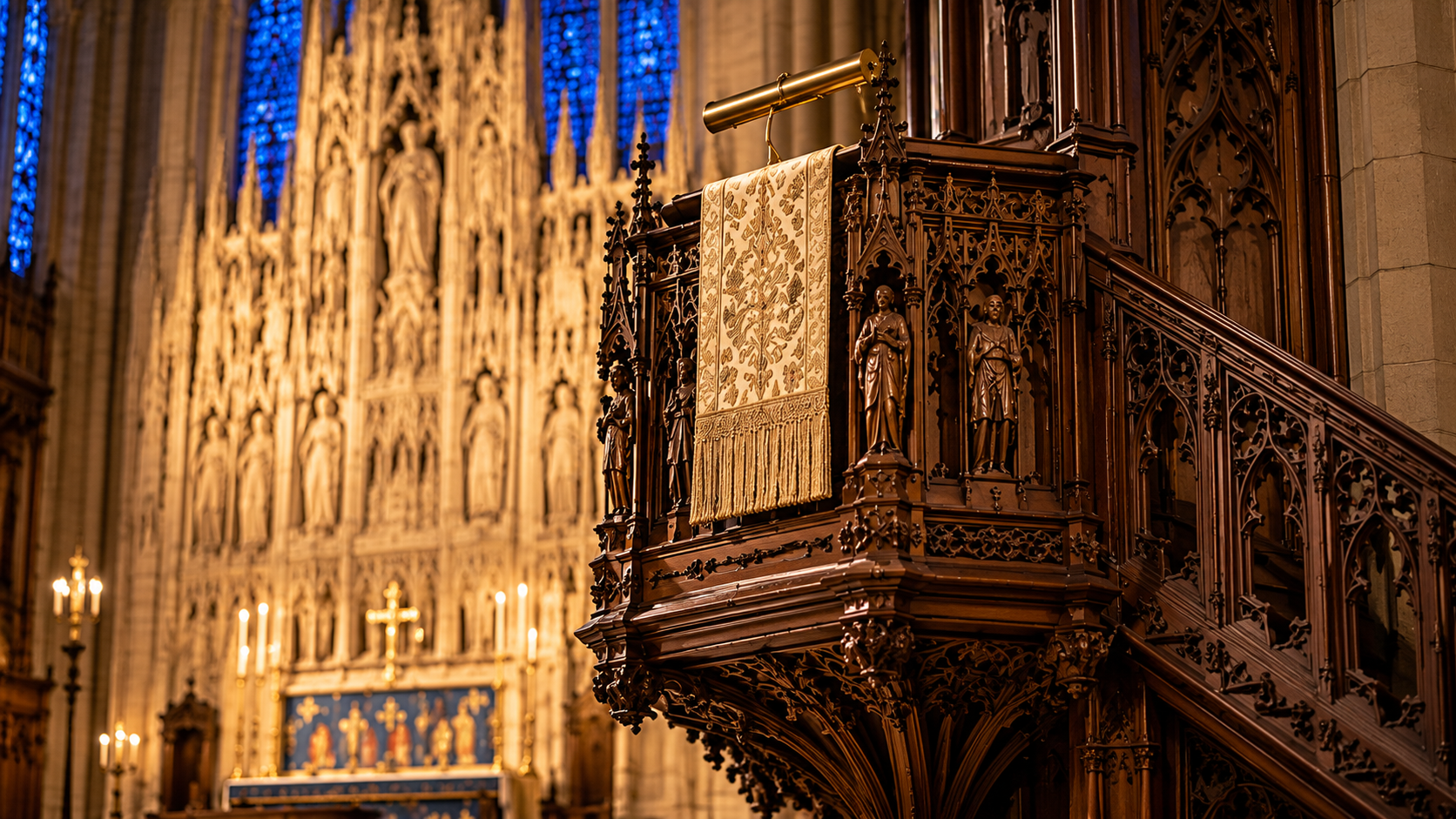
Preaching in The Episcopal Church is lackluster.
Not every preacher in every pulpit, but across the board, our kerygmatic witness is weaker than it should be. I know, immediately there are clergy feeling defensive (I’m probably not talking about you) or others who would defend TEC to the hilt on any matter. For putting you on the back foot immediately, I apologize, but I meant to do it.
Before providing a solution, you may be wondering how I arrived at my diagnosis, or rather, why preaching matters at all in our patch of Christianity. The answer is simple: we worship a wordy, loquacious, garrulous God who has chosen to reveal and communicate God-self to humans through words, spoken and incarnate. Preaching matters because Christianity is constituted by a God who speaks. Weak proclamation, therefore, represents a theological deficiency in the Church's response to God's self-communication.
God spoke the cosmos into being through his word; God spoke to Abraham and fashioned a people for himself; the word of the LORD came to the prophets; and ultimately the word became flesh. While our liturgies are wordy, the liturgy has two climaxes: proclamation and sacrament. Word and Table stand in a mutually interpretive relationship. Neither is merely preparatory to the other, and neither exhausts the Church’s encounter with Christ. We Episcopalians ought to care deeply about preaching precisely because of our liturgical tradition, not despite it. Renewed preaching is necessary for the integrity of Anglican-Episcopal worship.¹
It is precisely at the intersection of preaching, the Word, and the liturgy that the late Episcopal priest, Robert Farrar Capon, has something useful to say almost three decades after the publication of his book, The Foolishness of Preaching.² At the time of its publication, Capon had been preaching for more than 45 years. Sandwiched between two pieces of homiletical bread – comments on the dangers of cult, creed, and conduct for the first piece and remarks on preaching from notes and manuscripts – Capon offers his ingredients for preaching.
He says, “Great sermons will always be in short supply.”³ We’ve all heard the rhyme about how sermonettes make christianettes. When a homiletics professor suggests that sermons should “be about two things: about Jesus and about 10 minutes,” it means we are forming clergy for ministry with Jesus-without-Christ Kerygma. Sermons such as these are no more than a TedTalk dressed up with spiritual and religious language lacking Christology or the Paschal Mystery.
Thankfully, Capon has suggestions for improving the state of homiletics. His ingredients for preaching make their home most comfortably within the ecosystem of the Anglican-Episcopal tradition. These, he would suggest, are the antidotes to his diagnosis. I have used Capon’s ingredients for the recipe, but the seasonings are my own.
INGREDIENTS FOR PREACHING
1. Make Scripture the Pantry of your Preaching⁴
Sermons are a word from God as expressed by the word of God (Scripture) with the Word made flesh (Christ) as its central referent. Our homiletical concoctions must be laden with the flavors of Scripture. The preacher must steep and marinate in the biblical narrative. She must sit under the weighty authority of the Word and be formed by the Word. We need a rich biblical and exegetical imagination flowing from a steady diet of reading the Bible. Ellen Davis suggests as much when she describes how “one scriptural memory triggers another.”⁵ When the only Scripture we are reading is the text(s) for Sunday, our preaching becomes flavorless and thin.
2. Hear the Scriptures
It is not a matter of simply reading Scripture for Capon. This is not about studying as an academic exercise, nor is it about being smart. Rather, it is about being smitten with the Word and falling in love with Scripture.⁶ We have been given an immense gift in the form of the Bible which helps us to know God more as a privileged site of encounter. The requisite exercise, therefore, is hearing not reading because God speaks his words to us. Learning to listen to what God is saying rather than bringing our pre-conceived notions or pre-determined direction to the text.
3. Read the Office
The Daily Office is the natural soil for reading Scripture. The BCP provides an avenue for you to read a large swath of Scripture over a two-year period.⁷ It is not the whole Bible, however. While we are notorious for leaving out the spicy bits and the passages determined to be “fly over” or awkward, it is still a healthy diet of the Bible. The Office forms the preacher by making reception of the Word precede proclamation of the Word.
4. Read it Aloud
Read the Office out loud rather than in your head. Our oral faith is aurally-formative. Hearing the Office and the Bible read aloud allows for words and phrases to land differently than they would in your mind. Listen for the pieces of Scripture that challenge you, stretch you, upset you, and ignite you. Sit with them. Reading aloud creates space for steeping and marinating in words about and from God.
5. Read it Until you Die
Somewhere along the way, Capon switches from talking about better sermons to describing the formation of better preachers. He suggests that you should read the Office until you die. Capon never seeks a quick fix or a set of rules to make preaching better because that would go against the gospel of grace which he loves and preaches. His focus is on forming preachers as women and men of Scripture and prayer for a lifetime of preaching.
Preaching is a craft that can be honed, and perhaps even mastered from a technical standpoint. The best preaching, the most faithful preaching, however, comes through formation over a long period of time. As Eugene wrote, a long obedience in the same direction. It’s forming the scriptural memory that Ellen mentioned. Capon’s comment to read the Office until you die is not legalism, but transformation through the word written, the word prayed, and the word incarnate.
6. Preach the Lectionary
The next ingredient is the lectionary. We can rail against the lectionary for all of its sins of omission and volition (I do it regularly), but the lectionary still provides a sturdy framework for biblical preaching. Capon suggests that “topical sermons are like topical anesthetics: they don’t go deep.”⁸ If we are to be formed by the word, under the word, for the sake of the word, then our sermons should both raid the pantry of Scripture regularly and be outlined and structured by a scaffolding of Scripture that is not of our own choosing. If sermonettes make christanettes, then lessonettes make preacherettes.⁹
7. Soak in Prayer
Capon finally arrives at prayer at the end of this chapter. And it’s not prayer in the form of the Daily Office, but in the form of one-on-one communication with God. Just as preachers should be soaked in Scripture, they should also be marinated in prayer. I find that praying before I read the text, while I’m reading the text, after I read the text, and throughout the entire writing process is the only way to keep my sermons from being an inner monologue or personal echo chamber.
I learned a valuable lesson from a boss during my first year of ministry. He encouraged us to never read the lessons for our sermons as part of our personal quiet time or daily devotion. We should have time in prayer and study separate from the work God has given us to do.
And I want to go even further now. As part of being soaked in prayer and reading the Office daily, I would encourage you to do so on Sunday morning before finishing or polishing your sermon. I think it is more than valuable. It’s invaluable. We face an occupational hazard of spending large amounts of time with prayer, Scripture, theology, and liturgy professionally but not devotionally. Yes, there are sermons to preach on Sunday morning, but the work is secondary time with the Lord. I do not regret a single minute I have spent on Sunday mornings praying the Office and reading Bible passages that have nothing to do with my sermon.
CONCLUSION
That’s a lot to digest.
Despite his rather brazen and blunt way of putting it, Capon was on something. Better preaching is not about techniques or tidbits; at least not solely. Better preaching flows from better formation as a preacher of the word by sitting under the word, falling in love with the word, praying the word, and then proclaiming the word.
Preaching in the Episcopal Church has grown lackluster, but we have been given the gift of the Word made Flesh. Our preaching may be foolish as compared to the so-called wisdom of the world, but preaching that Word is not fruitless. Great sermons may always be in short supply. Faithful preachers need not be.
As women and men entrusted with the ministry of proclaiming the faith of the patriarchs, prophets, apostles, and martyrs, our task is not merely to make gains Sunday by Sunday, but to undertake the slower work of forming preachers saturated in Scripture and soaked in prayer. Only then can all our attention to craft find its fullest flavor profile.
NOTES
1. While I am picking on Episcopalians as an insider, I believe renewed preaching and pulpits are necessary in every corner of Christianity.
2. Robert Farrar Capon, The Foolishness of Preaching. Grand Rapids, MI: Eerdmans. 1998. Hereafter referred to as TFP.
3. TFP, 55.
4. TFP, 60.
5. Ellen F. Davids, Preaching the Luminous Word, 246.
6. TFP, 62.
7. Non-Anglican/Episcopalians have a Breviary or alternative lectionary (common or otherwise) tool for daily use.
8. TFP, 63.
9. TFP, 75.