
This sermon was originally preached at Church of the Redeemer on November 22, 2026 for Christ the King Sunday. The appointed lections were Ezekiel 34:11-16, 20-24; Psalm 100; Ephesians 1:15-23; Matthew 25:31-46
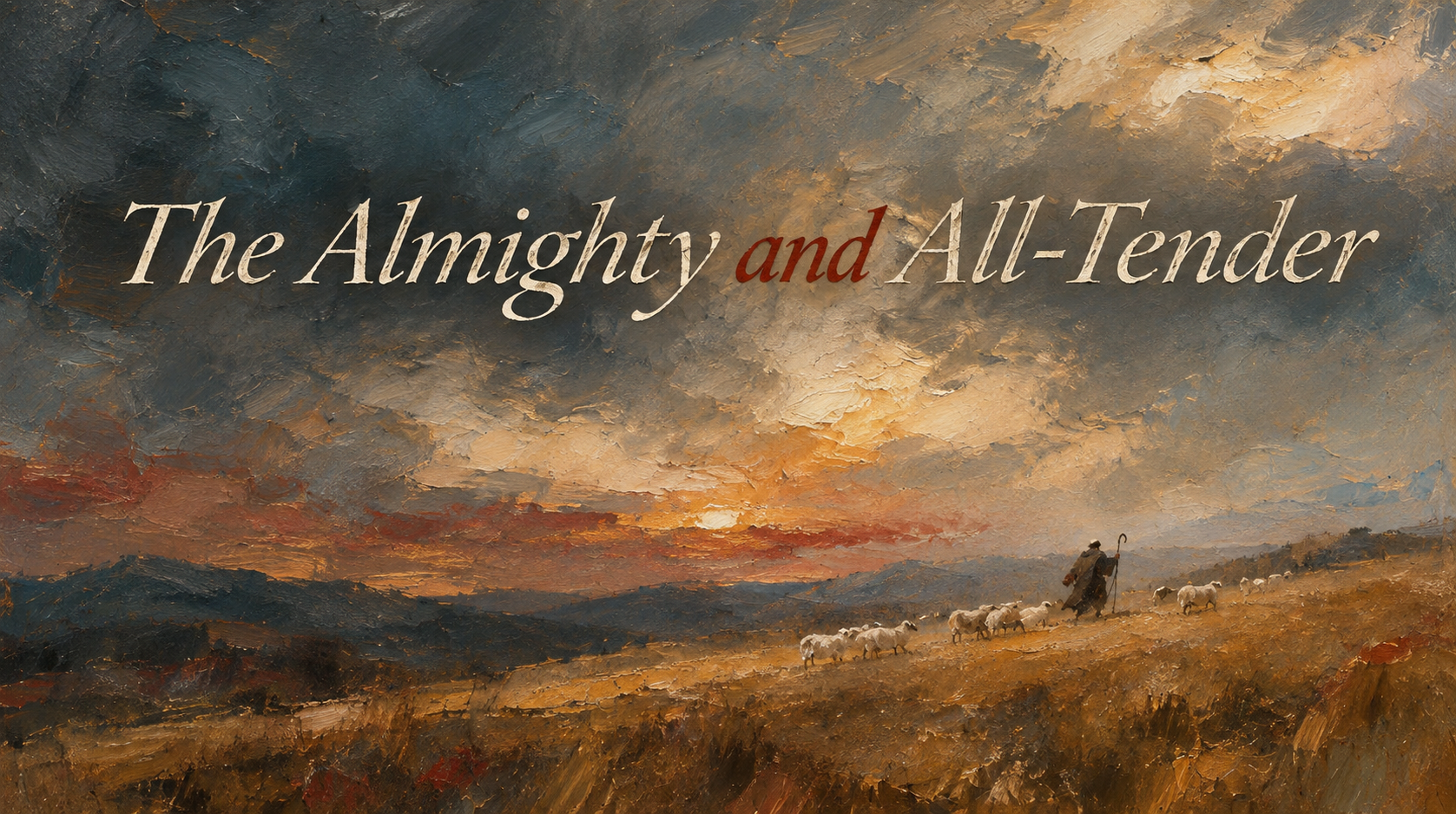
The Almighty and the All-Tender
Just 4 days after her husband was buried and a mere week after he was assassinated in Dallas, Jacquie Kennedy invited Theodore H. White, a Life magazine journalist, to the family estate in Massachusetts for an interview. With one swift sentence, the young widow cemented her husband’s 1,000 days in office into national folklore. She said, “Don’t let it be forgot, that for one brief, shining moment there was Camelot.”
One of her secret service agents would later claim this statement was neither accidental nor flippant, but rather a well-planned and well-executed (pardon the pun) attempt to solidify Kennedy’s legacy.
And the remarkable thing about it is that it worked!
We will never know how Kennedy would have been remembered in presidential history without the tragedy of 11/22/63 and the casting of Camelot a week later. The 1960 election was not a landslide–in fact, it was the closest presidential race since 1916. JFK and LBJ defeated Nixon and Lodge by 84 electoral votes…but the popular vote was only won by a margin of approximately 113,000.
The close race forgotten in the shadow of Camelot.
For nearly seven decades, the Kennedy family remained a power player in American politics. After JFK, Bobby played the lead until his assassination in 1968. Their younger brother, Ted, served in the Senate from 1962 until his death in 2009. Their sister, Jean, was the US Ambassador to Ireland. Bobby’s son Joseph served in the House of Representatives for 12 years, followed by Bobby’s grandson, Joseph Kennedy III, who served from 2013–2021.
Between 1953 and 2021, a span of 68 years, there were only two years when a Kennedy wasn’t in public office in the US Senate, House, or White House.
Camelot was real; it endured.
But the inconceivable happened in 2020: Joe III lost his bid for the US Senate. “The loss mark[ed] the first time a member of the political dynasty ha[d] come up short in a race for Congress in Massachusetts.” Most journalists couldn’t wait to print the obvious headline:
Camelot was over.
Camelot was lost.
Camelot was dead.
For nigh on 70 years, the Kennedys had stood alongside the Adamses, Roosevelts, and Bushes as one of America's great political dynasties. But with Joe's loss, the apparent birthright of Kennedy political office had come to an end.
Camelot represented a brief, shining vision of American greatness: youth, elegance, idealism, and the promise of a new generation ushering in a brighter future. The Kennedys were more than a political family; they became the embodiment of a distinctly American mythology in which power, privilege, public service, and national destiny seemed to converge. It was the promise of a golden age, made all the more compelling because it ended so tragically.
Next Sunday marks a new beginning, a new liturgical year, when we start our ancient Advent anew and afresh. That means today is an ending and we know how this story ends. It is the same ending with which many Christians have concluded the liturgical year for the last century:
It ends with Christ the King;
Jesus shall reign where’er the sun!
Crown him with many crowns!
Christ the King Sunday always presents the twin images of Jesus’ reign and rule: the almighty and the all-tender; the omnipotent and the omnicompassionate. Both sides matter because you cannot have one without the other. You cannot have the loving God without also having the living God.
I want to start by looking at Christ the Almighty in Ephesians 1, before looking at Christ the All-tender in Matthew 25, Psalm 100, and Ezekiel 34.
Ephesians 1 is a Pauline prayer on behalf of the Christians in Ephesus. This set of verses is actually one long sentence…Paul was never one for a solid sentence structure.
Paul is praying with abundant gratitude. The little phrase in verse 16, “For this reason,” should have us asking the obvious question: for what reason? In verse 15 we discover the answer: the Ephesians have both believed the Gospel and shown love to other believers. This is the classic connection between faith and love: faith leads to love and true love is founded in faith. Like a sine-wave going on for infinity.
The prayer has three sections and our passage is but the first. Specifically, Paul prays that the Ephesians might understand three things:
Their hope is in Christ (1:18)
Their riches are from Christ (1:18)
Their power is through Christ (1:19-23)
The key to understanding this triad of hope, riches, and power is to see that they are not just interrelated, but that the hope and riches are only made possible because of the power!
Their hope is in Christ. The hope to which they are called is eternal life in and through the Son. As the Collect suggests, Christ is the well-beloved son through whom all things will be restored. He will make all things new and in the fullness of time we will be fully redeemed.
Paul envisions the day when all of the sad things will come untrue, when suffering and sickness, when sighing and crying are no more. We have hope because Jesus has been raised from the dead, triumphant over sin, suffering, death, darkness, and the devil. We proclaim our hope when we say Christ has died, Christ is risen, Christ will come again and it enables the hopeful (them, us) to ask, O death, where is your sting? O grave, where is your victory?
In Christ, the would-be-emperor, Satan, has no clothes!
Their riches are from Christ. These riches are not a robust Roth IRA, an AmericanExpress black card, or a Vanguard account with lots of zeros at the end. These are the riches of the glorious inheritance we have in and through Christ. Jesus is the firstborn of all creation, the onliest begotten son of the Father, and to him belongs all of the glory, splendor, honor, riches, and power. We have been adopted into his family and are treated as the firstborn son, as co-heirs of all God’s promises. This is only made possible in and through Jesus.
Speaking of inheritances, brothers Mukesh and Anil Ambani inherited the world’s largest estate when their father died in 2002 without a will. The value of that inheritance was 42 billion dollars each. That's a 42 with NINE zeros after it. In a tale of two fates, Anil went bankrupt while Mukesh has more than doubled his wealth. As of yesterday, Forbes calculates Mukesh’s net worth at $96.1 billion dollars, making him the 21st richest person in the world. Friends, his wealth pales in comparison to the glorious riches of our inheritance through Jesus.
It’s mere drops in the bucket.
It’s chump change.
That $96.1 billion cannot be taken into the afterlife;
It cannot put a stopper to death;
It cannot prevent calamity.
But for those in Christ, we are given an eternal and everlasting inheritance because all of God’s promises are “yes and amen.” He is both our covenant maker and covenant keeper and his word never fails.
The riches and hopes come from the power of God displayed in and through Jesus Christ!
The power of his greatness is immeasurable, incomparable, inexhaustible, incomprehensible.
It is all-sufficient, wholly holy, and utterly other.
It is the power by which Jesus was raised from the dead, ascended to heaven, and is seated at the right hand of the Father.
It is an everlasting power because it is for both this age and the next age which has no end.
Jesus is the true messianic and davidic King who is seated upon the throne, now and forever and forever more. And it is because of this power that we have hopes and riches.
In Christ we have the almighty, the immortal and invisible on our side and he is reigning and ruling over all things as we await his second coming when he will return in power, majesty, and glory to judge both the quick and the dead.
Paul wants us to remember and hold tightly to our hope, riches, and power because he who began a good work in us will see it through to completion!
This is soaring language, isn’t it?
It’s lofty and uplifted because God is lofty and uplifted.
It’s the kind of verbiage that makes you want to shout Alleluia and have all of God’s people say, Amen, isn’t it?
And we could stop, but we won’t because we’re only halfway home.
Christ the Almighty is also full of tender-hearted compassion.
The Son of Man who is the King of kings and Lord of lords, the one who is crowned with many crowns, is also a shepherd. Like his ancestor David before him, he is the shepherd-king.
We find out in Matthew 25 that the shepherd king will separate the sheep from the goats. This is our cue to look backward with our exegetical memories to Ezekiel 34 and Psalm 100 so we can explore the vital role of shepherds in Israel. The sheep we are discussing, by the way, are far more than our ovine counterparts…we’re talking about us!
Despite some of Ezekiel’s crazy visions – like fiery flying wheels and a valley of dry bones coming to life like the coats of armor in Bedknobs and Broomsticks – Ezekiel gives us a very normal, pastoral vision in chapter 34. Here, God speaks out against the priests and religious leaders of Israel, a group of people whom he describes as shepherds.
The shepherds have not been performing their duties as keepers of the flock or comforters of the sheep entrusted to their care. Let’s start with the negative by looking at how the so-called-shepherds of Israel have been failing in their God-given vocation:
In verse 21 we read: “Because you pushed with flank and shoulder, and butted at all the weak animals with your horns until you scattered them far and wide.” This is predatory and abusive behavior wherein the strong and fat dominate the weak and lowly.
If we go back to the beginning of the passage, God begins by saying, “Woe to you shepherds.” It is never a good thing to be on the receiving end of a divine “woe” from God.
In verse 2, God accuses the shepherds of feeding their own mouths instead of the sheep.
In verse 3, we read that the shepherds have taken the fat, clothed themselves with the wool, and slaughtered the fattened calves…but they have not fed the flock.
This is an abject and abysmal failure of leadership by the very individuals to whom God entrusted the spiritual care and well-being of his flock.
The job of a shepherd is to protect and to provide, to care and to comfort, to rebuke and to restore, to lead and to love.
A shepherd is supposed to be trustworthy and selfless, taking care of the sheep without thought of reciprocity. In our own context, the shepherds are church leaders – pastors, priests, and preachers – and it pains me to say that there are pastors masquerading as shepherds when they are really feasting upon the sheep rather than feeding the flock.
What does a failure of leadership look like in a modern context?
For starters, it looks like abusive power wherein pastors rule over and dominate their churches in an authoritarian manner with an iron fist, using a bully pulpit for their power politics or personal proclivities.
It looks like pastors using the tithes and offerings of the church as their own personal finances, buying designer clothes, outrageously expensive shoes, private jets, and luxury cars worth more than the annual budget of this parish.
It looks like church leaders, both ordained and lay, who prey upon their sheep for their own sexual pleasures. It’s horrific that I even have to say this because it should be so obvious that this kind of behavior is unacceptable and evil, and yet every day women, men, and children created in the image of God are misused and abused by the very people who have pledged their lives to take care of them.
Finally, it looks like shepherds failing the flock through their inaction, their silence, their passive complicity, and their unwillingness to step in and step up to defend their flock from predators.
Every day, there are new stories and scandals of abuse, of moral failures among pastors, of shepherds who have forsaken the calling and traded in their crooks for wolves’ clothing. There is an element of judgment, therefore, present in both Ezekiel 34 and Matthew 25 as God promises to give the fat and strong justice rather than mercy because of their horrendous abuse of the flock.
This passage is not all bad news, though.
In fact, there is very good news for us!
While the shepherds of Israel have failed the flock, God has promised to fulfill the role of the Good Shepherd with his steadfast love and tender heart. He tells the people that he will bind up the injured, heal the sick, strengthen the weak, bring back the strays, and search for the lost.
The flock in Ezekiel had been scattered far and wide, all because of Israel’s spiritual and moral failings, and yet God promised to come on a search and rescue mission, leaving the 99 to find the 1. He is fiercely committed with a relentless resoluteness to redeem, restore, and reconcile. He will mend broken hearts, he promises healing for the downtrodden and distraught, he pledges his own power to the weak and the meek.
With Jesus as our Shepherd, the abused will find verdant pastures; the misused and mistreated will find living waters; the overlooked and left out will graze, tasting and seeing that the LORD is good; the weak and lowly will enjoy a banquet table in the presence of their enemies.
Psalm 100 tells us that God is the Shepherd and we are his sheep. The shepherd knows us intimately because he made us, knitting us together in our mother’s womb, and we belong to him. And his faithfulness is not just for today but for tomorrow and forever, enduring from age to age, without tarnish or blemish.
And here is the thing about God as our Shepherd: when the going gets tough, human leaders tend to get going, but God promises to never leave, forsake, or abandon his people.
Fast forward to chapter 10 of John’s biography of Jesus and you will find Jesus proclaiming, “I am the Good Shepherd.” He is the one who has come as the Shepherd King to care for the flock, to bind, heal, strengthen, bring back, and search.
Matthew 25 suddenly makes more sense as we read about the clothing of the naked and the giving of water to the thirsty and visiting people in prison. These are all extensions of Jesus’ shepherding, tender-hearted work. Jesus has come to find the least, the last, the lost, the lonely, and the little. His heart burns with steadfast love, tender mercy, and abundant compassion for sinners and sufferers, ragamuffins and wretches like you and me.
Beloved, it’s not about Camelot but rather the true and eternal Kingdom.
The Good News of Jesus Christ is that the one who is seated upon the throne is both the Great High Priest and sacrifice;
He is both the lamb that was slain and the Good Shepherd;
He is both the Almighty and the all-tender One.
He is our King, our hope, our inheritance, and our power.
He is the one who cares for the flock with a fierce ferocity and tender tenacity.
To him be glory and honor forever and forever more. Amen!
BONUS - ALTERNATIVE OPENING
Rebecca and the boys will tell you that I am a creature who loves rhythms, routines, and rituals.
The month between Thanksgiving and Christmas is perhaps the most ritual-laden period of the secular calendar. Here is what that means in our family:
We end Turkey Day by watching You’ve Got Mail;
On Black Friday we bring out the Christmas boxes and decorate the house from top to bottom;
It means Spode Christmas Tree china, White House ornaments, and my nutcracker collection.
It also means a consistent, unwavering menu: Turkey, cranberries, biscuits, green beans, cornbread dressing…is anyone else hungry?
A few years ago, however, the winds of change began blowing.
While I thrive on tradition, Rebecca is most in her element when she is doing something new and adventurous. Rebecca loves to try new things, specifically new recipes. In 2023, it was roasted carrots with a Greek yogurt and feta cheese dressing. We also spatchcocked the turkey, a significant deviation from years past. Despite the change, heaven forbid, it was all to die for. This got me thinking: what are the most bizarre and exotic turkey recipes on the market?
Here the top 7 that I stumbled upon:
Turducken
Tofurkey
The Donut-Turkey (aka Tur-Dunkin)
Turkey Cake
Turkey and Jell-o
Turkey and Gravy Pizza
Hot Cheetos Breaded Turkey
What was most offensive on the list and why was it Turkey and jello?
The Christian life is full of rhythms, routines, and rituals. We have a weekly rhythm with Sunday coming every 7 days. And I’ll be honest, some weeks it feels like Sunday comes faster than others. We have the seasonal routines of Advent, Christmastide, Epiphany, Lent, Eastertide, and the season after Pentecost as we trek through the cycle of Jesus’ life.
Next Sunday marks a new beginning…